

Identity Guard vs LifeLock comes down to one uncomfortable fact: most of the reviews ranking them take money from both sides. Strip that out and the choice gets simpler. LifeLock sells breadth with fine print it publishes. Identity Guard sells a lower price with fine print it buries. Here’s what each one costs, covers, and quietly caps.
- Identity Guard vs LifeLock at a glance
- Who owns each one, and who pays the reviewers
- Pricing: the first year is a teaser for both
- The insurance math nobody reads
- Monitoring and alerts: depth against breadth
- What happens when your identity actually gets stolen
- Which one should you pick?
- The $0 alternative both companies hope you skip
- Frequently asked questions
- Is Identity Guard better than LifeLock?
- Who owns Identity Guard and LifeLock?
- Does LifeLock actually pay you back if money is stolen?
- Why did my price jump at renewal?
- Does Identity Guard still use IBM Watson?
- Can I get identity theft protection for free?
- Which is cheaper for a family?
- My Take
Identity Guard vs LifeLock at a glance
This is the version neither marketing team puts side by side: renewal prices instead of teaser prices, and real cash caps instead of headline insurance numbers.
Prices reflect the promo blocks each site showed us in July 2026. Both companies rotate discounts, sometimes on the same page at the same time. More on that below.
Who owns each one, and who pays the reviewers
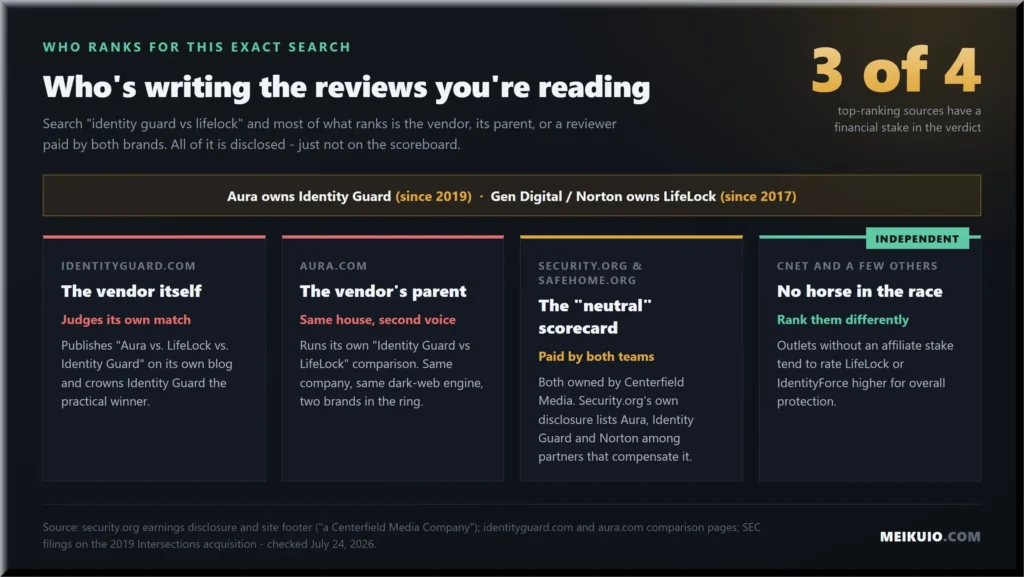
Identity Guard belongs to Aura. SEC filings date the deal precisely: the acquisition agreement for Intersections Inc., Identity Guard’s parent, was signed on October 31, 2018, closed on January 11, 2019, and the combined company renamed itself Aura that July. LifeLock belongs to Gen Digital, the company behind Norton, Avast, and AVG, which picked it up through Symantec’s $2.3 billion purchase in 2017.
That matters because of what ranks when you search this exact matchup. Identity Guard’s own site publishes a comparison of Aura, LifeLock, and Identity Guard, and crowns Identity Guard. Aura’s site runs another one. And the top-ranked independent scorecard, security.org, is a Centerfield Media company whose earnings disclosure lists Aura, Identity Guard, and Norton among the partners that compensate it. Its sister site safehome.org, same owner, runs the same matchup with the same affiliate links.
All of this is technically disclosed. Security.org lists its partners on a separate page and says it maintains editorial independence. But when the referee is paid by both teams, you read the scorecard differently. The few voices without a horse in the race, CNET among them, tend to rank LifeLock or IdentityForce higher for overall protection, which tells you the friendly consensus around Identity Guard is at least partly bought.
Pricing: the first year is a teaser for both
Identity Guard sells three tiers: Value, Total, and Ultra. On annual billing the first year runs $90, $200.04, and $300 for individuals. Those are promo prices. Renewal unwinds the discount, and every single plan lands at roughly 20% more: Value renews at $107.88, Total at $239.88, Ultra at $359.88. Family plans follow the same curve, $150 in year one for Value up to $479.88 renewal for Ultra.
It gets stranger. During our check, identityguard.com served two promo blocks at once: a “Save 16%” grid and a “Save 50%” grid with different first-year prices. Land on the deeper discount and Value costs $53.88 in year one, then renews at the same $107.88. That’s a 100% jump. Which version you see is luck; the renewal price is the real price.
LifeLock, after years of renewal complaints, now does something unusual with its standalone tiers: Core ($124.99), Advanced ($199.99), and Total ($349.99) renew at exactly the same number, printed right on the card. The renewal trap survived by moving into the bundles. Norton 360 with LifeLock Select jumps from $99.99 to $159.99 in year two, a 60% increase. Advantage goes $199.99 to $259.99, Ultimate Plus $299.99 to $364.99. First-year bundle prices rotate (we saw two different Select prices the same day), but the renewal figures held steady in every observation. We broke down the full tier structure in our LifeLock deep-dive.
Whole-dollar values reproduce the original graphic’s rounding; full table retains exact pricing terms. Source labels jumps of 100%, 60%, 22%, 20%, zero and zero. Both Identity Guard promotional blocks were served simultaneously; first-year Norton bundle promos rotate. LifeLock standalone renews flat; the increase is in Norton 360 bundles.
The insurance math nobody reads
Both brands wave million-dollar insurance at you. The numbers behind the wave are where they split.
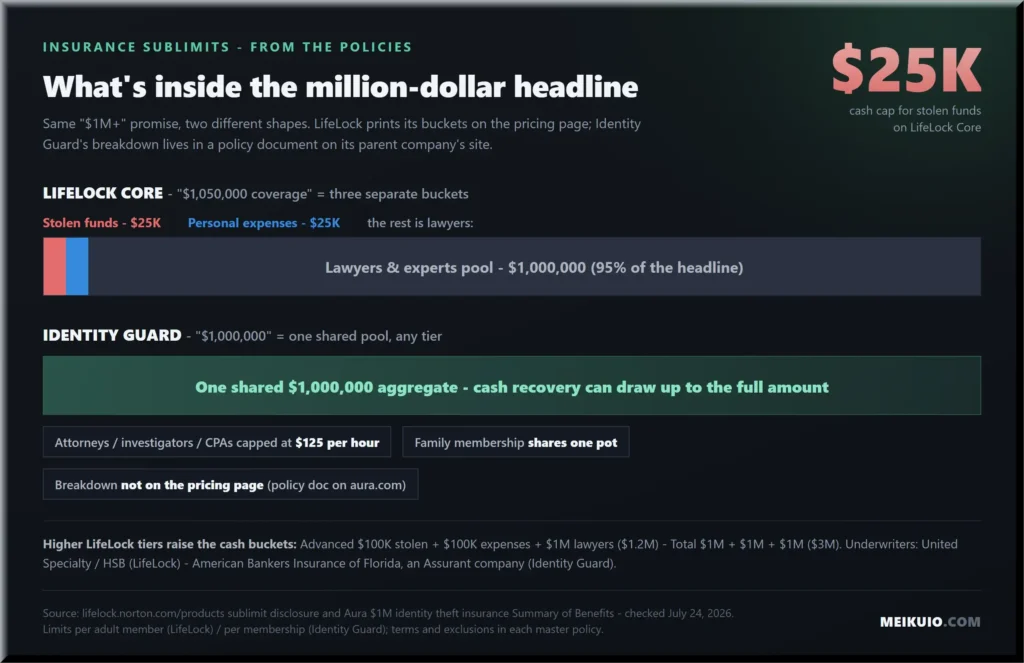
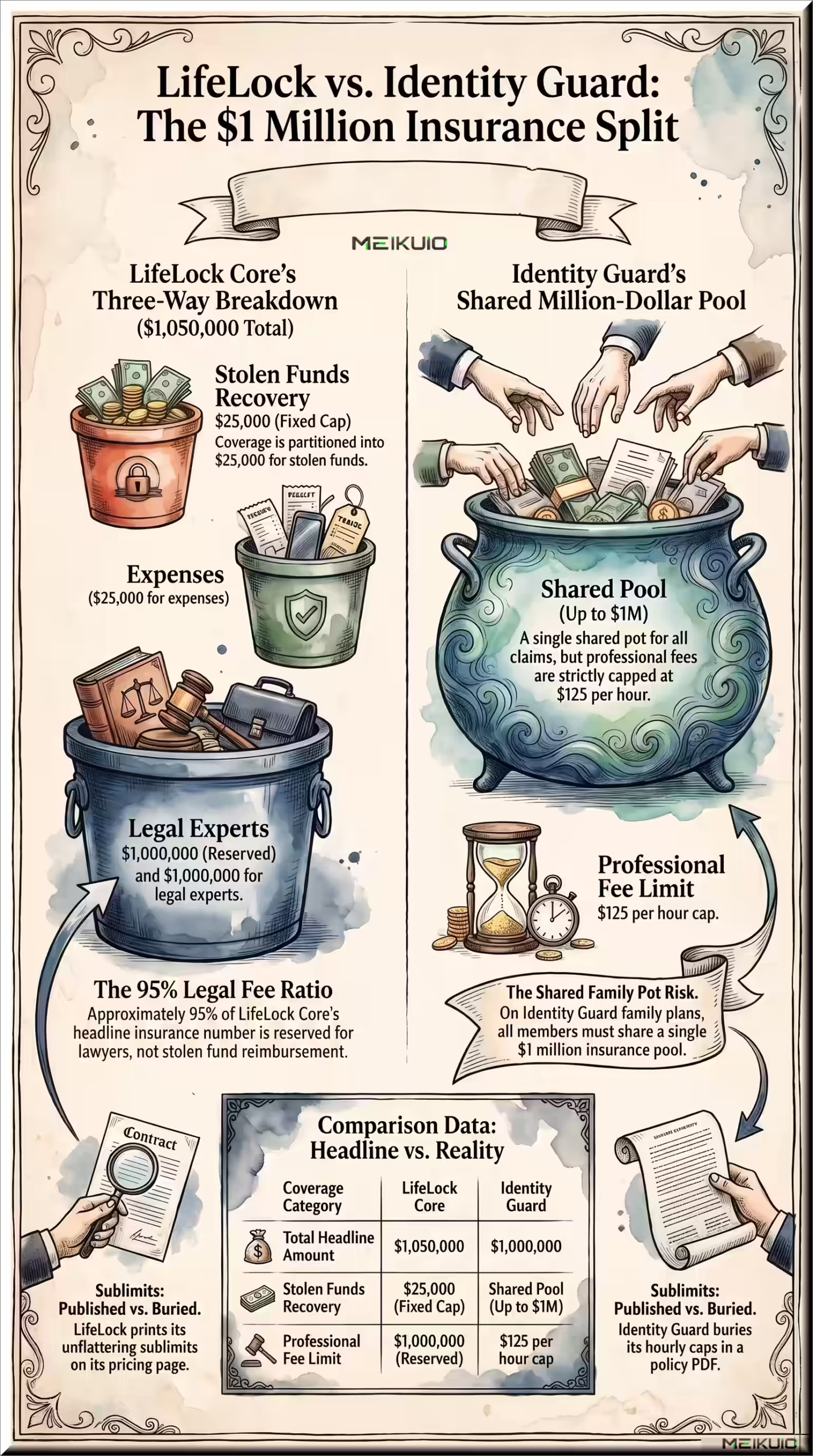
LifeLock prints its breakdown on the pricing page, and credit where due: the numbers are unflattering. Core’s $1,050,000 headline splits into $25,000 for stolen funds, $25,000 for personal expenses, and a $1,000,000 pool for lawyers and experts. About 95% of the headline is legal services you may never use. Advanced raises the cash caps to $100,000 each. Only Total, at $349.99 a year, backs stolen funds with a full $1 million. Underwriting sits with United Specialty Insurance (State National for New York residents), with scam coverage through HSB.
$25,000 is the actual stolen-funds cap behind LifeLock Core’s $1.05M headline. Identity Guard doesn’t publish its breakdown on the pricing page at all.
Identity Guard’s pricing page says $1 million for individuals, up to $5 million for families, and stops there. The terms live in a policy document on Aura’s legal pages, underwritten by American Bankers Insurance Company of Florida, an Assurant company. Read it and the shape turns out different: one shared $1,000,000 aggregate per membership per 12 months, with cash recovery drawing from the same pool. In theory that means stolen-funds reimbursement can reach the full million even on the $8.99 tier, which beats LifeLock Core’s $25,000 cap on paper. In exchange, attorneys, investigators, and CPAs are capped at $125 per hour, and a family membership shares one pot.
So who’s stingier? Wrong question. LifeLock caps the cash and shows you. Identity Guard caps the hourly rates, shares the pool, and makes you dig. Neither headline number describes what you’d collect, and the honest takeaway is to read the policy shape, not the big number.
Monitoring and alerts: depth against breadth
Entry tiers are the trap on both sides. Identity Guard Value, the $8.99 plan everyone quotes, includes no credit monitoring at all. You get dark web scans, breach alerts, and high-risk transaction monitoring, nothing that touches a credit bureau. LifeLock Core at least watches two bureaus. Move to the mid-tiers and both watch all three; that’s Identity Guard Total and LifeLock Advanced, almost identically priced.
More Read

At the top, the gating diverges. Identity Guard saves USPS address-change monitoring, criminal and sex-offense records, home and auto title alerts, and 401(k) monitoring for Ultra. LifeLock hands investment-account alerts to Advanced and up, and its TransUnion credit lock comes with every standalone tier, while Identity Guard’s Experian lock is Ultra-only.
One claim needs retiring. Reviews still credit Identity Guard with “IBM Watson AI” monitoring. The live identityguard.com doesn’t use the phrase anywhere; the current pitch is fraud alerts “up to 4x faster than the competition,” no Watson in sight. The branding survives only in third-party reviews, a fair measure of how often those get re-checked.
On scams, LifeLock’s bundles carry Genie, Norton’s AI scam detector for email, texts, calls, and deepfakes, and its standalone tiers reimburse scam losses at $5,000 on Advanced and $10,000 on Total. Identity Guard lists no scam-call protection on its plans page. Given that AI voice-cloning scams now need three seconds of audio to imitate a family member, that gap matters.
What happens when your identity actually gets stolen
LifeLock staffs US-based restoration specialists around the clock on every plan, with priority routing for Advanced and Total. Identity Guard has a US care team on all tiers too, but its White Glove Fraud Resolution is locked to Ultra, and it doesn’t advertise 24/7 phone access. That’s the support gap the price difference partly buys.
Neither makes claiming easy: expect documentation requests and police reports before anyone pays. Both collect the kind of complaints that don’t show up in star ratings. A LifeLock customer told the Better Business Bureau this June:
“When I finally had my identity stolen, their response was I needed to prove someone stole my identity… had to call the company that allowed theft and provide certified documents they couldn’t help with.”
BBB customer review, June 5, 2026
Identity Guard’s side of the ledger looks similar. From a ConsumerAffairs review this June:
“Very inefficient service with too many reporting gaps… does not catch new accounts timely… alert data incomplete, misleading, or wrong.”
ConsumerAffairs customer review, June 24, 2026
Billing friction is its own category. LifeLock’s terms let it charge up to 35 days before renewal, which matches what one BBB reviewer described in June 2026, along with “deceptive website architecture to block refund requests.” Identity Guard’s 60-day money-back guarantee, annual plans only, must be claimed by phone. LifeLock at least offers self-service cancellation online. Small print, but it decides whether leaving takes two minutes or two phone calls.
The long records differ too. LifeLock has paid the FTC twice: $12 million in 2010 over false “guaranteed protection” claims, then $100 million in 2015 for violating that first order, which FTC chair Edith Ramirez called the largest monetary award the commission had ever obtained in an order enforcement action. Identity Guard and Aura carry no comparable regulatory history; Aura’s one public blemish is a reported vishing incident in March 2026 that it says touched fewer than 20,000 active customers and no Social Security numbers. Past behavior isn’t destiny, but in an industry selling trust, it belongs in the file.
Which one should you pick?
Four profiles cover most readers.
- You want one subscription for devices and identity. Norton 360 with LifeLock is the only option here that includes antivirus and a VPN. Budget for the renewal jump, or plan to renegotiate every year.
- You want predictable pricing and real cash coverage. LifeLock standalone Advanced: $199.99 flat at renewal, three bureaus, $100,000 stolen-funds cap, published sublimits.
- You’re covering a big household on a budget. Identity Guard Family Total: five adults and unlimited kids for $300 in year one, three-bureau monitoring. Know that the insurance pool is shared and the breakdown isn’t published.
- You mostly want a safety net you’ll never think about. Check what you already have first. Some insurers now include identity protection free with an existing policy; Allstate started doing exactly that in 2026.
The $0 alternative both companies hope you skip
No paid service prevents identity theft. Asking is identity theft protection worth it comes down to understanding that every product on this page is a reactive alert system with an insurance policy stapled on. The preventive tools are free by federal law, and they attack the fastest-growing category directly: Javelin’s 2026 study counted $27.3 billion in identity-fraud losses across roughly 18 million US victims, with new-account fraud up 31% in a year.
The free stack: freeze your credit at Experian, Equifax, and TransUnion (blocks most new-account fraud outright), set an IRS Identity Protection PIN (blocks fraudulent tax returns), freeze your ChexSystems file (blocks fraudulent bank accounts), and turn on transaction alerts at your bank and card issuers. That combination covers the prevention layer better than any subscription, because freezes stop fraud instead of reporting it. What it doesn’t buy you is restoration help and insurance, which is the honest case for paying at all.
Frequently asked questions
Is Identity Guard better than LifeLock?
Identity Guard is better for large families on a budget; LifeLock is better for coverage transparency, scam protection, and anyone who wants antivirus bundled in. LifeLock publishes its insurance sublimits and holds standalone renewal prices flat. Identity Guard is cheaper up front but renews about 20% higher and doesn’t publish its insurance breakdown.
Who owns Identity Guard and LifeLock?
Aura has owned Identity Guard since January 2019, when it acquired parent company Intersections Inc. LifeLock has been part of the Norton family since Symantec’s $2.3 billion acquisition in 2017; the parent is now called Gen Digital. Keep both facts in mind when reading comparisons, since each owner publishes rankings featuring its own product
Does LifeLock actually pay you back if money is stolen?
Up to a cap that depends on your tier: $25,000 on Core, $100,000 on Advanced, $1 million on Total. The rest of the advertised $1.05M to $3M is mostly a pool for lawyers and experts. Claims require documentation and go through underwriter United Specialty Insurance, not LifeLock itself.
Why did my price jump at renewal?
Because the first year was a promo. Identity Guard’s discounts unwind at renewal, adding about 20% (or up to 100% after a “Save 50%” first year). LifeLock moved its increases into the Norton 360 bundles, which rise 22% to 60% in year two, while standalone LifeLock plans now renew flat.
Does Identity Guard still use IBM Watson?
Identity Guard’s own website no longer mentions IBM Watson anywhere; the current marketing promises alerts “up to 4x faster than the competition.” The Watson claim lives on in third-party reviews written years ago. Treat any comparison still leading with it as a sign the review hasn’t been updated recently.
Can I get identity theft protection for free?
The prevention layer is free by law: credit freezes at all three bureaus, an IRS Identity Protection PIN, a ChexSystems freeze, and bank transaction alerts. Paid services add monitoring, restoration help, and insurance, but they react to theft rather than prevent it. Deepfake and voice-clone scams also have free detection tools worth knowing.
Which is cheaper for a family?
Identity Guard, in most cases. Its family plans cover five adults and unlimited kids ($150 to $399.96 in year one), while LifeLock’s standard family setup covers two adults and up to ten kids, with Total family plans reaching $749.99. The trade: LifeLock gives each adult a separate insurance limit, Identity Guard’s family shares a pool.
My Take
I spent two days inside both companies’ policy documents and came out convinced the “vs” question everyone types is framed wrong. These products differ less in what they monitor than in what they admit. LifeLock tells you its entry tier caps stolen funds at $25,000; Identity Guard makes you find a policy PDF on its parent company’s site. In a category built on trust, I’ll take the company that shows me the unflattering number. If you just want cheap family coverage, Identity Guard works. If you want to know exactly what you bought, that’s LifeLock, and it says something that this is the bar.