



Quantum computing stocks are the hottest theme trade of 2026, and one of the most dangerous. The sector’s benchmark index is up about 69% this year, yet not one of these companies can run a commercially useful calculation. This guide cuts through the hype: what’s real, what’s accounting theater, and the honest ways to get exposure without torching your savings.
- The three ways to buy in
- Why are quantum computing stocks soaring in 2026?
- What can quantum computers actually do right now?
- The “Quantum Four”: the high-risk pure-plays
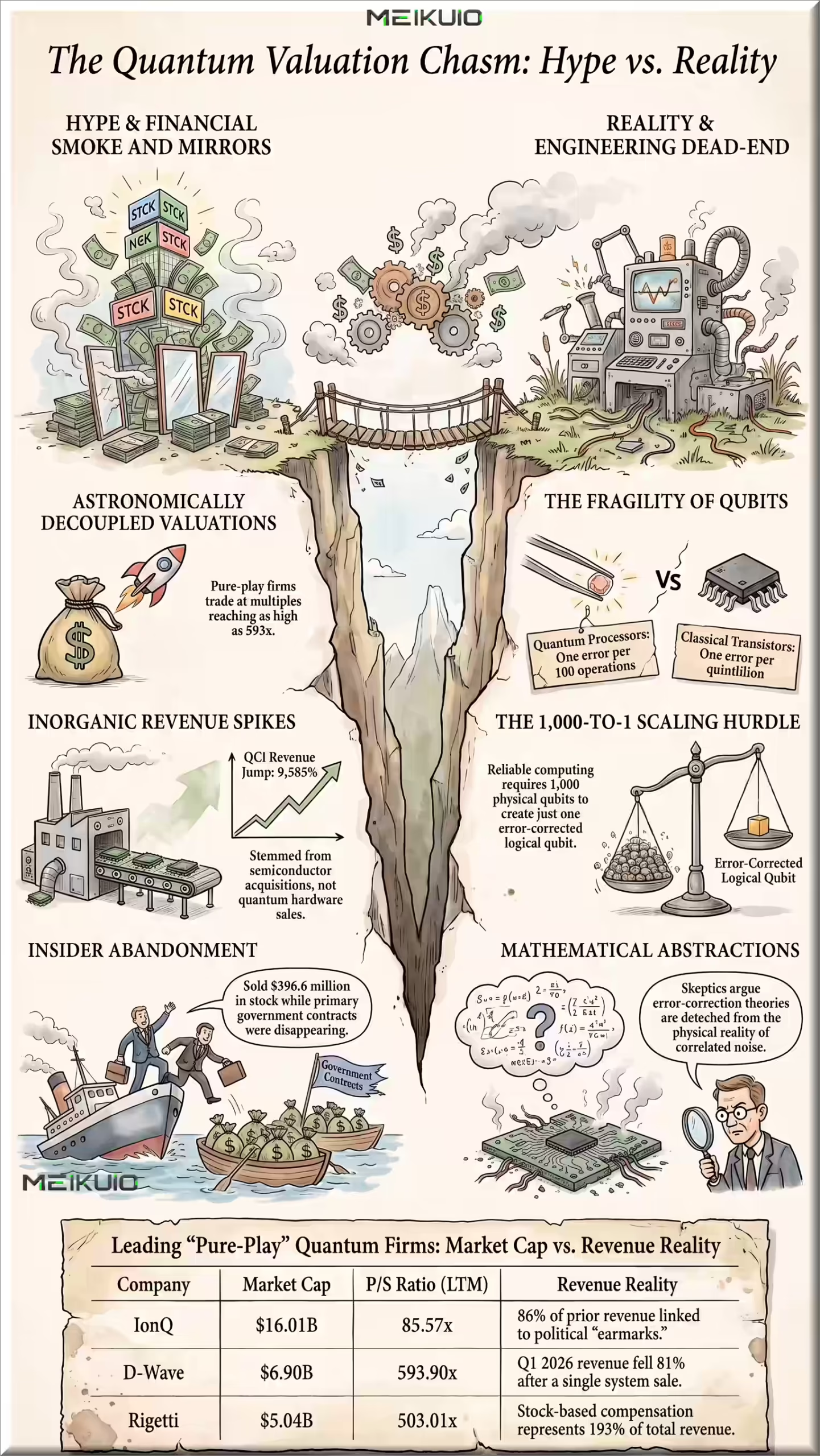
- The valuation problem in one picture
- The safer play: big tech with quantum arms
- Can you actually buy Quantinuum?
- Follow the government money
- The ETF route, and how it works for the US, Canada, and Australia
- How big is the quantum market, really?
- So should you buy quantum computing stocks?
- Key facts at a glance
- Frequently asked questions
- Are quantum computing stocks a good investment in 2026?
- What is the best quantum computing stock?
- Can I buy Quantinuum stock?
- Is IonQ profitable?
- What’s the safest way to invest in quantum computing?
- How are quantum stocks different from AI stocks?
- My Take
This is analysis, not financial advice. I’m not a licensed advisor, and these are some of the most volatile stocks on the market. Only risk money you can afford to lose, and talk to a professional before you buy.
Original benchmark period retained. Much of the quantum index’s gain came from component suppliers rather than quantum pure-plays.
The three ways to buy in
Before you touch a single ticker, know which game you’re playing. There are three, and they carry wildly different risk.
Most people who ask me about “quantum stocks” mean the first row. That’s the row that can go up 30% in a day and give half of it back the next.
Why are quantum computing stocks soaring in 2026?
The rally runs on narrative, not numbers. Two things lit the fuse this year: AI’s power problem, and Washington. Classical AI data centers are slamming into energy limits, and quantum gets pitched as the way around them. Then in May the U.S. government announced a $2 billion bet on the sector. Product revenue had almost nothing to do with any of it.
Here’s the part nobody puts on the poster. That headline 69% gain? It mostly didn’t come from the quantum companies. Inside the S&P Kensho quantum index, the “sub-components and materials” slice is only 12% of the weight but delivered 73% of the return. The actual quantum hardware names are 59% of the weight and produced just 16%. Picks-and-shovels suppliers carried the sector while the marquee stocks lagged.
The 69% rally was carried by component suppliers, 12% of the index’s weight but 73% of its return, not the quantum companies themselves.
And the pure-plays? For most of 2026 they were red. Before the government news broke on May 21, D-Wave was down about 26% year-to-date, Rigetti down 24%, Quantum Computing Inc down 7%. The announcement spiked them 25% to 31% in a session, then June handed a lot of it back with drawdowns of 21% to 25%. If you bought the “up 69%” story, you bought a headline that already happened, to companies you probably weren’t holding.

What can quantum computers actually do right now?
Not much you’d pay for. As of mid-2026 there is still no confirmed “quantum advantage” on a single commercially useful problem. That’s not a skeptic’s hot take, it’s the current state of the field.
A quantum computer is a machine that stores information in qubits instead of ordinary bits. A normal bit is a 0 or a 1. A qubit can sit in a superposition of both at once until you measure it, and qubits can be entangled so their states depend on each other. In theory that lets the machine explore an enormous space of possibilities in parallel. In practice, qubits are fragile. A stray vibration, a temperature wobble, an electromagnetic nudge, and the calculation collapses into noise. So the whole industry lives or dies on one metric: the error rate.
Today’s machines sit in what researchers call the NISQ era, for “noisy intermediate-scale quantum.” Current processors make roughly one error every 100 to 1,000 operations. A classical chip makes about one every quintillion. To get useful work done, you bundle hundreds or thousands of noisy physical qubits into a single reliable “logical” qubit, and the rough consensus is you need around 1,000 physical for 1 logical. Google’s Willow chip (105 qubits, December 2024) showed error rates falling as the system scaled, a real milestone. The largest logical-qubit cluster demonstrated so far is 96, from QuEra in January 2026. Cracking the encryption that protects your bank would take millions of physical qubits. Leading machines are in the low hundreds.
When do the companies themselves promise fault-tolerant machines? IBM says 200 logical qubits by 2029. D-Wave targets 100 logical by 2032. The consulting firm Arthur D. Little, after surveying the field, puts commercially useful fault-tolerant computers at least seven to ten years out. Every one of those dates is a goal, not a guarantee, and the sector has a long history of missing them. IBM’s own 2022 roadmap promised a 1,092-qubit machine by 2025. It slipped to 2027.
The “Quantum Four”: the high-risk pure-plays
These are the stocks people actually gamble on. All four are deeply unprofitable at the operating level, and their revenue is microscopic next to their market values. Read that twice, because the earnings headlines will tell you otherwise.
IonQ (IONQ) is the giant of the group, built on trapped-ion technology. Its Q1 2026 revenue of $64.7 million was up 755% year over year, it holds $3.1 billion in cash, and its order backlog hit $470 million. It even reported “net income” of $805 million. That last number is a mirage: it came almost entirely from a $1.06 billion non-cash gain on revaluing warrants. Strip that out and IonQ lost $271.5 million from operations. In February a short-seller, Wolfpack Research, alleged that most of IonQ’s older revenue traced back to defense earmarks that have since dried up; the CEO resigned weeks later. IonQ disputes the report. Notably, when the government handed out its $2 billion, IonQ, the biggest name in the sector, wasn’t on the list. The stock is down roughly 48% from its 52-week high. One thing the roadmap slides skip: in May 2025 IonQ also bought a controlling stake in ID Quantique, and what that hardware actually delivers is the subject of our quantum key distribution reality check.
Rigetti Computing (RGTI) builds superconducting chips. Q1 2026 revenue was $4.4 million, up 193% from a tiny base, but full-year 2025 revenue actually fell 34% to about $7 million. It, too, reported a GAAP “profit” that was pure warrant accounting; operating loss was $26 million. At its spring highs it traded near 836 times sales. For context, an expensive software stock trades around 15 to 25 times sales.
D-Wave Quantum (QBTS) is the odd one out, running both quantum annealing and a newer gate model. Its Q1 revenue fell 81% to $2.9 million, but that’s a quirk: the prior year included a one-time $12.6 million system sale. Bookings, by contrast, jumped nearly 2,000% to $33.4 million. It holds $588 million in cash. The company did land a $100 million government commitment, in exchange for issuing $100 million in stock to the Commerce Department.
Quantum Computing Inc (QUBT) is the smallest and strangest, a photonics play. Revenue climbed to $3.7 million from basically nothing, but the jump came from acquisitions, not quantum sales. More than 60% of its roughly $1.4 billion value is just cash, and its single biggest source of income is the interest on that cash. It also carries the highest short interest of the four, around 26% to 30% of its float.
Times sales at spring highs, not current multiples. Software comparator 20× is illustrative; article quotes approximately 15–25× for an expensive software stock.
The valuation problem in one picture
Strip away the roadmaps and the physics and you’re left with a simple mismatch: billions in market value sitting on top of a few million dollars in sales. The GAAP “profits” at IonQ and Rigetti make it worse, because a casual investor reads “net income” and assumes the business works. It doesn’t, yet.
Net income reflects approximately 1.06B USD non-cash warrant revaluation. Operating result is a loss of 271.5M USD. Neither figure is revenue or cash flow.
Net income reflects approximately 1.06B USD non-cash warrant revaluation. Operating result is a loss of 271.5M USD. Neither figure is revenue or cash flow.
The people closest to these companies are voting with their own shares. Through late May, insiders across the four had sold a net $931 million in stock since 2021: about $576 million at IonQ, $295 million at D-Wave, $60 million at Rigetti. Buying was rounding-error small. Meanwhile the companies keep printing new shares to fund themselves. In 2025 alone the four raised $4.15 billion through stock sales, and Quantum Computing Inc’s share count grew 74% in a year. Every share you buy is worth a little less by the next quarter.
The skeptics here aren’t just bears talking their book. Oxford physicist Nikita Gourianov argues the little revenue these firms generate “mostly comes from consulting missions” rather than real quantum advantage. Mathematician Gil Kalai of Hebrew University goes further and argues large-scale fault-tolerant machines may be physically impossible. They could be wrong. But when the physics community is this split, “priced for perfection” is a strange place to be.
The little revenue they generate mostly comes from consulting missions… as opposed to genuinely harnessing any advantages quantum computers have over classical ones.
Dr. Nikita Gourianov, quantum physicist, University of Oxford
The safer play: big tech with quantum arms
If you want quantum exposure without betting the farm, the giants hand it to you almost for free. Quantum is immaterial to their revenue, so you’re buying a real business with a lottery ticket stapled on.
IBM has the deepest ecosystem and the clearest roadmap (Starling, 200 logical qubits by 2029), plus a $1 billion government award for a new chip foundry. Alphabet’s Google Quantum AI produced the Willow breakthrough. Microsoft is chasing topological qubits, though its Majorana claims are hotly disputed by other physicists. Nvidia doesn’t build quantum hardware at all; it sells the connective tissue (its NVQLink links quantum processors to GPUs), which is arguably the smartest picks-and-shovels position in the whole sector. Amazon offers quantum through AWS Braket. None of these will move on quantum news. All of them let you own the theme without the 25%-down-days.
If you’re weighing these against the broader AI trade, our rundown of the best AI stocks to buy covers the same names from the AI angle.
Can you actually buy Quantinuum?
Yes, as of June 4, 2026. Honeywell’s quantum unit, Quantinuum, went public on the Nasdaq under the ticker QNT, priced at $60 a share, and raised $1.68 billion. It runs trapped-ion technology and claims the industry’s highest gate fidelity. Two things to know before you get excited. First, this was an IPO, not a spin-off, so existing Honeywell shareholders did not automatically receive QNT shares. Second, Honeywell and Cambridge Quantum still control about 82% of the company, so the public float is thin. For the record, Quantinuum booked $30.9 million in 2025 revenue against a $192.6 million net loss. Better than its pure-play peers, still a long way from a business.
Note
This was an IPO, not a spin-off. If you already hold Honeywell stock, you did not automatically receive Quantinuum (QNT) shares.
Follow the government money
In May 2026 the U.S. government did something unusual: it became a shareholder. The Commerce Department signed letters of intent worth $2.013 billion across nine companies, taking a minority equity stake in each, a structure modeled on the government’s earlier stake in Intel.
The tell is who’s missing. IonQ, the largest pure-play, didn’t make the list, which is either a red flag about its technology or a quirk of the paperwork, depending on who you ask. One more caveat: these are letters of intent, not closed deals, and the actual share issuance hadn’t been confirmed in filings as of this writing. Outside the U.S., Australia is funding a PsiQuantum fab in Brisbane for roughly AUD 940 million, though the new Queensland government has put that deal under review.
This is a familiar pattern for anyone following how governments and markets now treat frontier tech. It’s the same “you can’t cleanly buy the thing everyone wants” story we hit with Neuralink stock and how to buy OpenAI stock.
The ETF route, and how it works for the US, Canada, and Australia
If you can’t tell trapped-ion from photonic and don’t want to, an ETF is the honest answer. You trade the jackpot for diversification.
QTUM (Defiance) is the broadest, with about 85 holdings, a 0.40% fee, and a year-to-date return around 36%. Fair warning: it’s really an AI-and-semiconductors fund with quantum flavoring, so don’t expect a pure bet. QNTM (VanEck) is a European UCITS fund, more concentrated, closer to a pure-play. WQTM (WisdomTree) is young and small but tilts toward the pure-plays too. Even these baskets carry a beta around 1.5, so they swing harder than the market.
For readers in Canada and Australia: the U.S.-listed ETFs are available through most international brokers, since the European PRIIPs rules that block them don’t apply to you. File a W-8BEN form to cut U.S. dividend withholding from 30% to 15%, and remember you’re taking on U.S.-dollar currency risk. Australians have almost no local pure-play option, just Archer Materials on the ASX.
Note
Canada and Australia: file a W-8BEN form to cut U.S. dividend withholding from 30% to 15%, and remember these funds trade in U.S. dollars, so you carry currency risk.
How big is the quantum market, really?
Nobody agrees, and the spread is almost comical. Estimates run from about $1.9 billion to $2.7 trillion. Both numbers get quoted as “the quantum market.” Neither is lying, exactly; they’re measuring different things.
Approximately 1.9B USD for 2033. This narrow vendor-revenue definition is deliberately separate from the 2035 estimates.
72B USD vendor revenue in 2035, not total economic value. The estimates have different definitions and years and cannot be treated as a common market-size range.
2.7T USD total economic value in 2035. Economic value is not revenue, and the difference from the other estimates is definitional, not a common market range.
The small numbers count revenue that quantum hardware and software makers actually collect. The giant numbers count the total economic value spread across pharma, finance, and materials firms that might one day use the technology. McKinsey estimates roughly 80% of that value lands with end users, not the quantum industry itself. So the trillion-dollar figure, even if it’s right, is mostly not money that flows to the stocks in this article. Don’t add these forecasts together, and don’t let the biggest one anchor your expectations.
So should you buy quantum computing stocks?
Consider a small position if you treat it as a lottery ticket, cap it at 3% to 5% of your portfolio, want exposure to the theme, and can stomach a 25% down week without panic-selling.
Skip the pure-plays if you need the money within five years, if you can’t explain what a logical qubit is, or if you’re buying because you saw “up 69%.” That move already happened, and mostly to companies you’ve never heard of.
The honest middle path for most people is a broad ETF or the big-tech names, which give you the theme without the binary risk.
Key facts at a glance
- Sector index (S&P Kensho Quantum): up about 69% in 2026 through May, versus 10.7% for the S&P 500.
- The Quantum Four: IonQ, Rigetti, D-Wave, Quantum Computing Inc, all deeply unprofitable operationally.
- Newest name: Quantinuum (QNT), public since June 4, 2026, at $60 a share.
- Government money: $2.013 billion across nine firms, IonQ excluded.
- Fault-tolerant machines: roadmaps point to 2029 to 2033 at the earliest.
- Price-to-sales: up to ~836 (Rigetti) at spring highs, versus ~20 for a pricey software stock.
- Best low-risk exposure: big-tech names (IBM, Alphabet, Nvidia) or a diversified ETF.
Frequently asked questions
Are quantum computing stocks a good investment in 2026?
For most investors, only as a tiny speculative slice. The technology is real and improving, but commercially useful machines are years away, the pure-play companies are unprofitable with extreme valuations, and the stocks routinely swing 20% or more in a month.
What is the best quantum computing stock?
There’s no clean answer, and anyone who gives you one quickly is guessing. Among the pure-plays, IonQ has the most cash and revenue, making it the least fragile. For lower risk, IBM and Alphabet offer quantum exposure inside real, profitable businesses.
Can I buy Quantinuum stock?
Yes. Quantinuum went public on June 4, 2026, on the Nasdaq under the ticker QNT at $60 a share. Keep in mind it was an IPO, not a spin-off, so Honeywell shareholders didn’t automatically receive shares.
Is IonQ profitable?
No, not in any real sense. IonQ reported GAAP “net income” in Q1 2026, but it came from a non-cash accounting gain on warrants. The company lost $271.5 million from actual operations.
What’s the safest way to invest in quantum computing?
A diversified ETF like QTUM, or large tech companies with quantum programs such as IBM, Alphabet, and Nvidia. Both give you exposure to the theme without betting everything on a single pre-revenue startup.
How are quantum stocks different from AI stocks?
AI stocks are backed by companies generating real, large revenue today. Quantum pure-plays are pre-revenue bets on a technology that isn’t commercially useful yet, which makes them far more speculative.
My Take
I’ve watched a few of these theme trades now, and quantum has the same fingerprints: an important technology, a handful of companies nowhere near monetizing it, and a stock chart that ran way ahead of the science. The tell for me this year wasn’t the 69% headline, it was where the gains came from. Component suppliers, not the quantum names. When a rally can’t be carried by the thing it’s supposedly about, I get careful. If quantum belongs in your portfolio at all, I’d keep it small, lean on an ETF or the giants, and treat any pure-play position as money I’ve already made peace with losing. The breakthroughs will keep coming. Whether today’s shareholders are the ones who get paid for them is a very different question.