

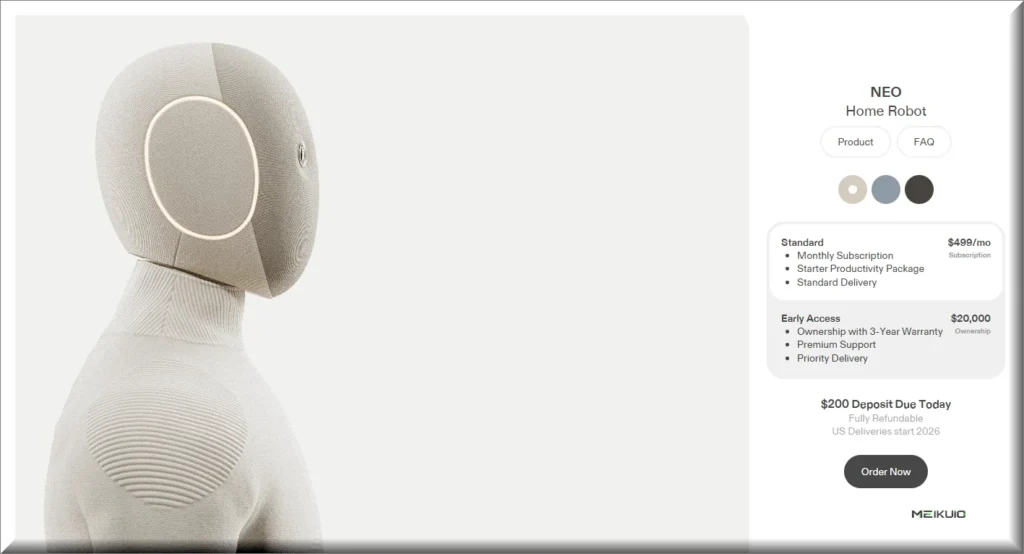
Humanoid robot prices in 2026 run from $1,400 for a knee-high hobbyist model to $320,000 for industrial machines. The number making headlines is $499 a month: that’s NEO, the home robot from 1X Technologies, now taking US orders with deliveries starting this year. Or buy it outright for $20,000. That answers the price question. The harder question is whether anyone should pay it.
- What $499 a Month Actually Buys
- The Catch: Sometimes a Human Is Driving
- The Math: Rent, Buy, or Wait
- Humanoid Robot Prices in 2026: What You Can Actually Buy
- Why the Industry Is Racing Anyway
- Who Should Order One (And Who Shouldn't)
- Frequently Asked Questions
- Is the 1X NEO robot actually autonomous?
- Can a human operator see inside my home through NEO?
- How much does it cost to rent a humanoid robot in 2026?
- Is the NEO deposit refundable?
- Can you buy a Tesla Optimus right now?
- What is the cheapest humanoid robot you can buy?
- How much does NEO cost to run?
- My Take
I went through every page of 1X’s fine print, the CEO’s interviews, and the one live demo that didn’t go to plan. Here’s what renting a humanoid actually gets you, and who should consider putting $200 down.
What $499 a Month Actually Buys
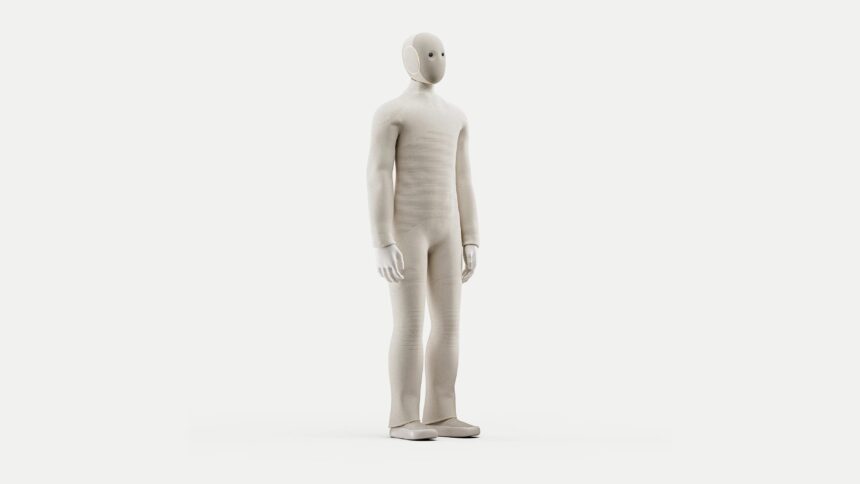
NEO is a 5’6″, 66-pound humanoid in a machine-washable knit suit, built by 1X in California. The spec sheet reads like the company designed it specifically to not scare your family. Soft lattice-polymer body. No exposed pinch points. Twenty-two decibels while working, which is quieter than your fridge.
The strength numbers are more serious than the cozy sweater suggests: it lifts 154 pounds, carries 55, and runs up to four hours per charge before walking over and plugging itself in. Under the hood sits an Nvidia Jetson Thor chip and 1X’s own Redwood AI model, plus a regular language model so you can just talk to it.
On day one it opens doors, fetches things, turns off lights. For everything else, 1X’s order page uses a sentence you should read twice: “NEO works autonomously by default. For any chore request it doesn’t know, you can schedule a 1X Expert to guide it.”
The “Expert” is a human being with a VR headset.
More Read

The Catch: Sometimes a Human Is Driving
CEO Bernt Børnich has been refreshingly blunt about this. In an interview on the New York Times’ Hard Fork podcast he called NEO “a data collection play” and admitted the obvious tension out loud: “There’s no doubt that you’re running towards a cliff.” Either autonomy improves as the fleet grows, or the economics of paying human teleoperators stop working.
His current numbers: NEO opens doors successfully “90 something percent” of the time on its own, and fetches objects at “maybe 80%.” Everything harder goes to a scheduled remote operator who sees through the robot’s cameras.
1X has clearly thought about how creepy that sounds. Operators are vetted and monitored, one manager per eight of them. People in the camera feed get blurred. Homes are anonymized behind a task-queue interface, and you set no-go zones and time windows yourself. The official data policy is unusually plain for this industry: “We do not use this data to build a profile of you, nor do we sell this data.” There’s an opt-out for training data too.
Note
Who sees your home, and when? Remote operators only connect during Expert sessions you schedule yourself. You control the rooms, the hours, and the opt-out. The trade: your housework becomes training data, and that’s exactly why the robot is this cheap.
Then there’s what happened when Hard Fork’s hosts actually tested one. The robot, driven entirely by an employee in another room, hugged a host and fetched a drink from the fridge. Fine so far. Then it dropped a pair of tongs, couldn’t pick them up off the floor, and nearly tipped over backward trying to squat. 1X blamed office Wi-Fi. The hosts landed on a phrase I can’t improve on: this is less a butler, more “an intern that needs a lot of your attention.”
The counterpoint: the intern is learning fast. In March 2026, 1X shipped a World Model update that lets NEO pick up tasks from watching video at internet scale, and recent footage shows it ironing a shirt and working a sliding door with no prior examples. Børnich’s bullish target for cleaner-level autonomy is 2027. His own bear case is 2029. Both dates are after your first subscription year ends. If the robot is meant to look after an aging parent, the machines a family can get today are a different list, covered in care robots for the elderly.
If a machine with eyes and hands living in your house makes you think harder about household security in general, good instinct. We’ve already covered how AI gets used against families in our guide to spotting AI voice scams.
The Math: Rent, Buy, or Wait
The subscription looks friendly until you run it forward.
Rent costs 2,994 USD at six months and 23,952 USD at 48 months. At 40 months it is 19,960 USD; it first exceeds 20,000 USD in month 41, with continuous intersection around 40.08 months. Original prose and graphic call this “month 40”; their wording is preserved. Electricity and deposit are excluded equally. Buying includes the stated three-year warranty and priority delivery. Earlier press reports cite a six-month rental minimum, while the maker’s FAQ does not.
Early coverage at eWeek and elsewhere put the subscription minimum at six months, which works out to about $2,994 to find out whether you like living with a robot. 1X’s own FAQ, though, never mentions a minimum term at all; it just says you pay monthly and can extend or return the robot at the end. Either way the arithmetic is simple. The subscription crosses the $20,000 purchase price at month 40. Run it four years and you’ve paid roughly $23,952, which is a $4,000 premium over owning.
The premium buys flexibility, and probably hardware. 1X iterates fast, and subscribers presumably ride upgrades while a buyer holds 2026-vintage machinery. Buying gets you a 3-year warranty and priority delivery; purchase customers get robots first, subscribers after.
Six months of NEO: $2,994. The subscription passes the $20,000 purchase price at month 40. Electricity is the cheap part: under $1 a day.
Running costs are almost a rounding error. 1X says NEO uses under a dollar a day in electricity from a standard outlet. And the $200 deposit stays fully refundable right up until your robot is ready to ship, which makes reserving a place in line close to risk-free.
Humanoid Robot Prices in 2026: What You Can Actually Buy
Every price guide buries the main fact: almost nothing on this market is purchasable by a normal person. The table looks crowded until you read the availability column. Prices as of June 2026. Wearable robots repeat the pattern one shelf over: the exoskeletons a private buyer can actually order stop well short of the medical class, which publishes no price at all.
The models serve different purposes; only NEO is a general-purpose home-robot reservation. NEO also offers 499 USD/month. The full current table retains delivery and geographic restrictions; a retail robotics platform is not a household chore robot.
USD. Targets and estimates, not retail offers. Tesla has no consumer preorders; Atlas is allocated to enterprise / research customers. No midpoint or actual purchase price is invented.
That headline-grabbing $5,900 Unitree everyone shares on social media? The base R1 Air is actually $4,900, and neither trim folds laundry. It’s a 4-foot development platform that does beautiful cartwheels, does zero housework, and the consumer version won’t even run your own code; Unitree reserves that for the pricier EDU edition (for hands-on builders, dedicated robot kits for adults offer far better transparency on true costs). Tesla’s Optimus, the robot people assume they’ll buy someday, cannot be ordered at any price. No waitlist, no deposit, no date. Just a Fremont line spinning up and “end of 2027” as the consumer target.
That leaves NEO in a strange spot: far from the most capable machine on this list, and the only one that will actually take your order.
Why the Industry Is Racing Anyway
Zoom out and the $499 subscription looks like what it is: a land grab.
Figure took its BotQ factory from one robot per day to one per hour in under 120 days this spring, per the company's April production update, with over 350 of its third-generation humanoids already delivered -- a trend reshaping manufacturing that we explore in humanoid robots and jobs. Hyundai and Boston Dynamics used CES 2026 to announce that every Atlas built this year is already spoken for, split between Hyundai's Georgia Metaplant and Google DeepMind, which is wiring its Gemini Robotics models into the robot's head. The same foundation-model arms race we tracked in Microsoft MAI versus Claude is now competing for bodies, not just chat windows.
The money has noticed. SoftBank's Masayoshi Son told CNBC in early June that physical AI is where he sees "the next trillion-dollar company" emerging, weeks after SoftBank closed a $5.4 billion purchase of ABB's robotics division. Wedbush's Dan Ives calls humanoids "the golden goose for physical AI." Morgan Stanley's long-range model puts the market at $5 trillion by 2050. And analyst firm IDTechEx projects average humanoid prices will fall 68% by 2030.
Sit with that last number. The robot you can rent today exists so the robot you'll actually want in 2030 can be trained. Big Tech runs this same play across every device category; it's the same logic that just put Gemini inside Siri. Everyone wants the data flywheel. The early customers are the flywheel.
Who Should Order One (And Who Shouldn't)
Order NEO if:
- You can treat $2,994 as the price of a front-row seat, not a purchase.
- You'll actually configure the no-go zones and schedules instead of ignoring them.
- You want to help train the first generation of home robots and find that exciting.
- A refundable $200 to hold a place in line sounds like cheap optionality (it is).
Skip it for now if:
- You expect a finished product; this is an intern with a safety harness.
- The thought of any scheduled remote access to your home is a hard no.
- You have small kids or pets and won't supervise; 1X's own guidance says stay attentive around both.
- You'd rather wait for the 2027--2028 wave, when the industry expects prices well below today's and autonomy that doesn't need a babysitter.
Field notes
- Consumer market status: 1X NEO is the only consumer humanoid accepting active pre-orders with 2026 US delivery.
- Pricing options: $499/month flexible subscription or $20,000 outright purchase; $200 fully refundable reservation deposit.
- Running economics: Under $1/day electricity cost from standard home outlet; rental cost equals purchase price at month 40.
- Physical specs: 5'6" height, 66 lbs weight, 154 lbs lift capacity, 22 dB whisper-quiet operation, 4-hour battery life.
- Autonomy reality: 90% success on doors, 80% on fetching; unlearned household tasks rely on scheduled human teleoperation.
- Price trajectory: IDTechEx projects average humanoid hardware prices will fall 68% by 2030 as mass manufacturing scales.
- Sources: 1X Technologies Official Order Portal (June 2026), NYT Hard Fork CEO Interview, IDTechEx Humanoid Robotics Analysis.
Frequently Asked Questions
Is the 1X NEO robot actually autonomous?
Partly. 1X says NEO works autonomously by default, and its CEO claims roughly 90% success opening doors and 80% fetching objects. Chores it can't handle go to a scheduled human teleoperator. Cleaner-level full autonomy is targeted for 2027 at the earliest.
Can a human operator see inside my home through NEO?
During scheduled Expert sessions, yes; that's how teleoperation works. 1X says operators are vetted and monitored, faces in the feed are blurred, homes are anonymized, and you set no-go zones. The company states it doesn't profile you or sell the data, and you can opt out of training data.
How much does it cost to rent a humanoid robot in 2026?
$499 per month. 1X's NEO is the only consumer humanoid on subscription. Early coverage cited a six-month minimum, about $2,994, though 1X's own FAQ specifies no fixed term. Buying outright costs $20,000. Both routes need a $200 refundable deposit.
Is the NEO deposit refundable?
Yes. The $200 deposit is fully refundable up to the point your robot is ready for delivery, per 1X's official FAQ.
Can you buy a Tesla Optimus right now?
No. As of June 2026 there are no Optimus preorders, no waitlist, and no announced date. Tesla's target is $20,000 to $30,000 at scale, with consumer availability aimed at the end of 2027.
What is the cheapest humanoid robot you can buy?
The Noetix Bumi at $1,400, a 94-centimeter hobbyist model sold in China. The cheapest full-size option is the Unitree R1 Air at $4,900, but that's a development platform, not a household robot (consumer quadrupeds are far more practical at home -- see our breakdown of robot dog prices).
How much does NEO cost to run?
Under $1 a day in electricity, according to 1X. It charges from a standard home outlet and plugs itself in when it's low.
My Take
I cover gadgets for a living, and the $200 deposit is the only no-brainer in this story: fully refundable, holds your place, costs you nothing but patience. I'd put it down today.
Converting that deposit into $499 a month is a different conversation. The privacy trade bothers me less than it bothers Reddit; a vetted, monitored, camera-logged teleoperator is more accountable than most strangers we already let into our homes. What stops me is the tongs. In 2026, a robot that can't pick up what it drops is a hobby that occasionally folds laundry, not hired help. Hobbies are fine. Just budget for one honestly.
Ask me again when the World Model demos stop being curated. If NEO's autonomy curve does what Børnich promises by 2027, this subscription becomes the best deal in consumer tech. If it doesn't, you'll have paid a few thousand dollars to watch the future rehearse in your living room. Some people will find that worth every cent. I'd be lying if I said I'm not tempted.