

DeepSeek V4 is an open-weight, MIT-licensed AI model that does something no frontier lab has matched: it runs a one-million-token context window at a fraction of the cost of Claude, GPT, or Gemini. Released as a preview on April 24, 2026, it comes in two sizes – V4-Pro (1.6 trillion parameters) and V4-Flash (284 billion) – and on coding benchmarks the top mode goes toe-to-toe with the best closed models, leading several outright. The catch: it trails the leaders on raw knowledge, and it’s text-only.
- Quick verdict
- What DeepSeek V4 actually is
- V4-Pro vs V4-Flash: which one is for you
- What DeepSeek V4 actually costs
- Where V4 wins, and where it loses
- Why 1M context is the real story
- Should you actually use it?
- Frequently asked questions
- Is DeepSeek V4 free?
- Can I run DeepSeek V4 on my own computer?
- What's the difference between V4-Pro and V4-Flash?
- Is DeepSeek V4 better than ChatGPT or Claude?
- Does DeepSeek V4 support images?
- What happened to deepseek-chat and deepseek-reasoner?
- My Take
Quick verdict
The short version: if you run agents, analyze huge documents, or just want frontier-class coding without frontier prices, V4 is the most interesting model of 2026. If you need vision, airtight factual recall, or a polished consumer app, the closed labs still lead.
More Read

What DeepSeek V4 actually is
DeepSeek is a Chinese AI lab that has spent two years releasing open-weight models that land within a few months of the closed frontier – then giving the weights away (driving a major enterprise wave where Chinese AI models now run 46% of US enterprise traffic). V4 is its biggest swing yet. Both models use a Mixture-of-Experts design, which means only a slice of the total parameters fires on any given token: V4-Pro activates 49B of its 1.6T, and V4-Flash activates 13B of its 284B. That’s how a trillion-parameter model stays affordable to run.
The weights are published on Hugging Face under the MIT license – the most permissive option there is. You can download them, run them on your own hardware, fine-tune them, and ship them in a commercial product without asking anyone. In the first month, the V4-Pro weights alone were downloaded more than two million times. For comparison, no version of GPT-5.5 or Claude Opus is downloadable at all.
One important limit up front: V4 is text in, text out. No image input, no image generation, no audio. DeepSeek has said multimodal support is on the roadmap, but today, if your workflow needs vision, this isn’t your model.
V4-Pro vs V4-Flash: which one is for you
The two versions aren’t a quality ladder so much as a size-and-cost trade-off. Flash is the smaller, faster, cheaper one; Pro is the heavyweight for the hardest work.
Here’s the part that surprised people: DeepSeek says Flash, given a larger thinking budget, reaches reasoning performance close to Pro. It only falls clearly behind on pure knowledge tasks and the most complex agent workflows – both of which lean on Pro’s far larger parameter count. For most everyday automation, Flash is the value pick. Pro earns its keep when the task is hard enough to need it.
What DeepSeek V4 actually costs
The headline isn’t the parameter count – it’s the bill. Here’s what DeepSeek charges per million tokens through its own API.
That's the whole disruption in one line. At $0.435 per million input tokens and $0.87 per million output, V4-Pro is a frontier-class coding model priced like a budget one - roughly an order of magnitude under what the closed labs charge for comparable coding ability. V4-Flash goes lower still. DeepSeek notes it can adjust prices, so for a real project, check the live pricing page before you budget.
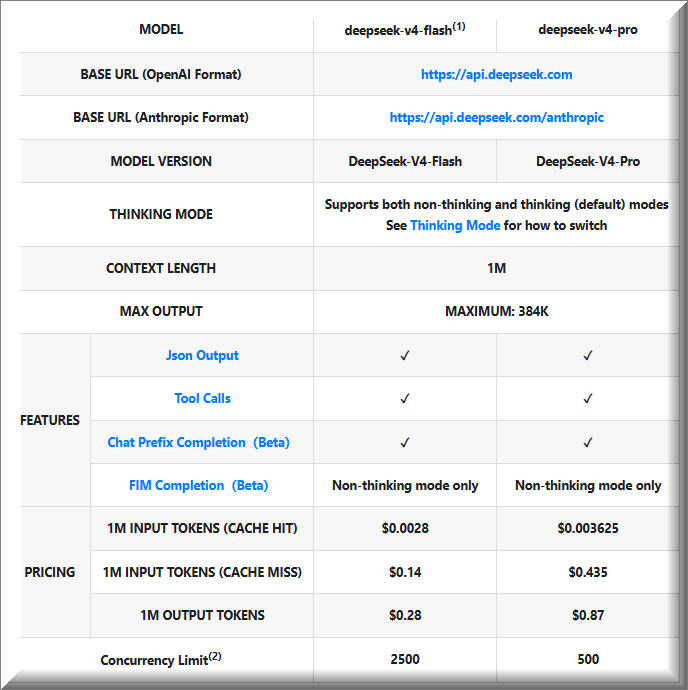
There's also a quieter line item that matters more than the headline rate if you run agents or RAG: the cache-hit price. When your prompt reuses a system prompt or document prefix that DeepSeek has already seen, that input is billed at the cache-hit rate - for V4-Pro, less than a hundredth of a cent per million tokens. For multi-turn assistants and agent loops with a fixed system prompt, that line effectively rounds to free.
Where V4 wins, and where it loses
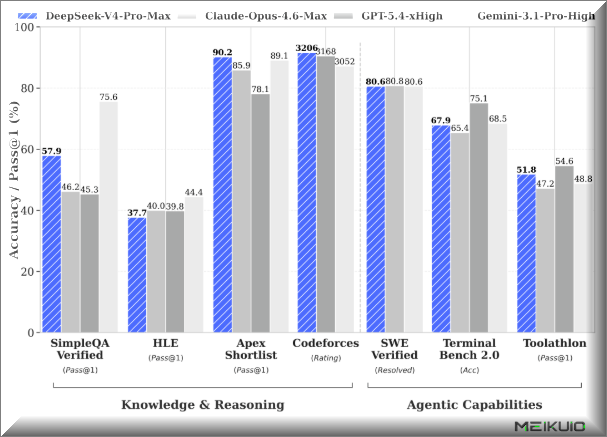
DeepSeek published full benchmarks comparing V4-Pro-Max (its maximum-reasoning mode) against the closed frontier. The honest read: it's at or above the leaders on code, and a step behind on knowledge.
On coding, V4-Pro-Max isn't keeping pace with the frontier - it's leading parts of it, topping LiveCodeBench and Codeforces in DeepSeek's own testing. On software-engineering tasks it sits in a dead heat with Opus and Gemini. That's the headline most coverage runs with, and it's earned.
The losses are just as clear. On the hardest knowledge and science benchmarks - GPQA Diamond, HLE - Gemini 3.1 Pro is still out front, and V4 trails. DeepSeek is refreshingly blunt about this in its own technical report, describing the model as trailing state-of-the-art frontier models by "approximately 3 to 6 months." That's the right way to read V4: not a frontier-killer, but a model that closes the gap to months and then hands you the weights.
Why 1M context is the real story
The benchmark numbers grab headlines, but the actual breakthrough is efficiency. Running a million-token context window normally means runaway memory and compute costs. DeepSeek's hybrid attention design - it interleaves two compression schemes it calls CSA and HCA - slashes both.
At a 1M-token context, V4-Pro uses roughly 3.7x fewer compute operations per token and 9.5x less memory than the previous DeepSeek generation. V4-Flash goes further still: about 9.8x fewer operations and 13.7x less memory. In plain terms, that's what makes a million-token context something you can run routinely instead of as an expensive party trick - and it's why DeepSeek built V4 specifically for long-running agent workflows that used to break halfway through a task.
Should you actually use it?
It depends entirely on the job. The honest answer splits cleanly.
Reach for DeepSeek V4 if you:
- Build coding agents or automate software tasks - this is its strongest suit, at a price nothing closed comes near (especially when comparing alternatives after the recent GitHub Copilot pricing changes).
- Work with huge inputs: whole codebases, long documents, multi-file analysis that needs the full 1M context.
- Want to self-host or fine-tune on your own hardware under a license with no strings (MIT).
- Run high-volume API workloads where the per-token cost is the difference between viable and not.
Stick with a closed model if you:
- Need image, audio, or any non-text input - V4 is text-only today.
- Depend on airtight factual recall, where Gemini 3.1 Pro still leads clearly.
- Want a polished consumer app with memory, integrations, and support, rather than raw model access.
- Can't tolerate a model that, by its maker's own admission, runs a few months behind the frontier.
Field notes
- Release date: April 24, 2026 (preview release).
- Open license: MIT license with open weights published on Hugging Face.
- Model versions: V4-Pro (1.6T total / 49B active) and V4-Flash (284B total / 13B active).
- Context ceiling: 1,000,000 tokens standard context; up to 384,000 tokens output.
- Inference pricing: V4-Pro at $0.435 in / $0.87 out per 1M tokens; V4-Flash at $0.14 in / $0.28 out.
- Benchmark highlights: LiveCodeBench 93.5, Codeforces 3206 rating, SWE-bench 80.6.
- Legacy retirement: Legacy endpoints deepseek-chat and deepseek-reasoner retire July 24, 2026.
- Sources: DeepSeek V4 Technical Report, Hugging Face Repository, Official API Documentation (api-docs.deepseek.com).
Frequently asked questions
Is DeepSeek V4 free?
The weights are free and open under the MIT license - you can download and run them yourself at no cost. The hosted API is paid but very cheap: V4-Pro runs about $0.435 per million input tokens. You can also chat with it free at chat.deepseek.com.
Can I run DeepSeek V4 on my own computer?
In principle yes, since the weights are open, but the full models are large - V4-Pro is a 1.6-trillion-parameter model. Most individuals run quantized versions through tools like vLLM, SGLang, or Ollama, and many teams choose the smaller V4-Flash for self-hosting because its hardware footprint is far more manageable.
What's the difference between V4-Pro and V4-Flash?
Pro is the larger, more capable model (1.6T parameters) built for the hardest reasoning and coding; Flash is smaller (284B), faster, and cheaper. Both share the same 1M-token context. For high-volume or latency-sensitive work, Flash is the value pick; for the most demanding tasks, Pro pulls ahead.
Is DeepSeek V4 better than ChatGPT or Claude?
On coding benchmarks, V4-Pro-Max matches or beats them in DeepSeek's testing. On raw world knowledge and the hardest science questions, closed models like Gemini 3.1 Pro still lead. DeepSeek itself estimates V4 trails the frontier by three to six months - but it's open-weight and far cheaper. For a deeper look at the closed leaders, see our ChatGPT vs Claude comparison.
Does DeepSeek V4 support images?
No. V4 is text-only - it accepts and produces text, with no image input, image generation, or audio. DeepSeek has indicated multimodal capabilities are planned, but they're not in this release.
What happened to deepseek-chat and deepseek-reasoner?
Those are the legacy API model names from the V3 era. They now route to V4-Flash, and DeepSeek will retire them entirely on July 24, 2026. If you call the API, update your model parameter to deepseek-v4-pro or deepseek-v4-flash before then.
My Take
The bigger picture is worth sitting with. A model this capable, handed out for free under an MIT license, completely reshapes who can build with frontier-class AI. For developers and teams building coding agents or processing million-token codebases, V4 breaks the pricing chokehold held by closed labs. While Gemini and Claude still lead on multimodal workflows and raw factual knowledge, DeepSeek has proven that open-weight intelligence can run shoulder-to-shoulder with the frontier at a fraction of the cost - and understanding the structural differences between open and closed labs is key, as we unpack in our investigation into who actually owns Claude.