

The best AI music generators in 2026 are Suno for full songs with vocals, ElevenLabs Music for commercially safe tracks, and AIVA for composers who want to own the copyright outright. That ranking is driven less by sound quality than by law. Udio makes brilliant audio you currently can’t download, Suno quietly rewrote who owns your songs, and a German court delivers the first major AI music verdict on July 31, 2026.
- Quick Verdict: All 9 Tools Compared
- Why “Best” Changed Meaning in July 2026
- Suno: The Best Songs, on a Lease
- Udio: Great Audio You Can’t Take Home
- Suno vs Udio: The Head-to-Head Everyone Asks About
- The Licensed-From-Day-One Crowd
- ElevenLabs Music: the safe default for songs with vocals
- Stable Audio 2.5: loops and sound design, clean data
- Soundraw: background music with a license that outlives you canceling
- AIVA: the only one that hands you the copyright
- The Wildcards
- Mureka: the producer’s toolbox with an asterisk
- Producer.ai: the one Google just bought
- Boomy and Musicfy: the quick and the niche
- Will Anyone Even Hear It? Platform Rules in 2026
- Do You Even Own What You Make?
- FAQ
- Can you use Suno songs commercially?
- Why can’t I download my songs from Udio?
- Do you own the copyright to AI-generated music?
- What happens after the July 31 GEMA ruling?
- Can you monetize AI music on Spotify or YouTube?
- Which AI music generator is fully licensed?
- My Take
I went through all nine platforms below with one question that no other ranking seems to ask: if you make a track today, what are you actually allowed to do with it? Sell it? Download it? Register the copyright? The answers turned out to be wildly different from tool to tool, and in two cases they changed within the last few months. I also ran the same prompt through the free tiers of Suno and Udio in mid-July 2026 to see what they hand over in practice, and you can listen to both results below. Spoiler: not a single file.
Quick Verdict: All 9 Tools Compared
Entry prices do not grant identical rights. ElevenLabs Starter allows limited commercial use; full rights cost 22 USD. Boomy full commercial rights require Pro at 29.99 USD. AIVA entry is approximately 12 USD, while copyright transfer is on Pro at approximately 33 EUR with annual billing. Udio downloads remain disabled. Soundraw requires annual billing. The full licensing table retains all conditions.
Why “Best” Changed Meaning in July 2026
Three dates this summer matter more than any feature release.
July 2, 2026. Judge Alvin K. Hellerstein in New York refused to let Sony Music expand its lawsuit against Udio by 30,442 recordings, keeping that case pinned to the 333 works in the original complaint. Good news for Udio. The same order kept alive Sony’s claim that Udio ripped training audio from YouTube by breaking its “rolling cipher” encryption, which means the way a company collected its data can violate the DMCA even if the training itself is one day ruled fair use.
More Read

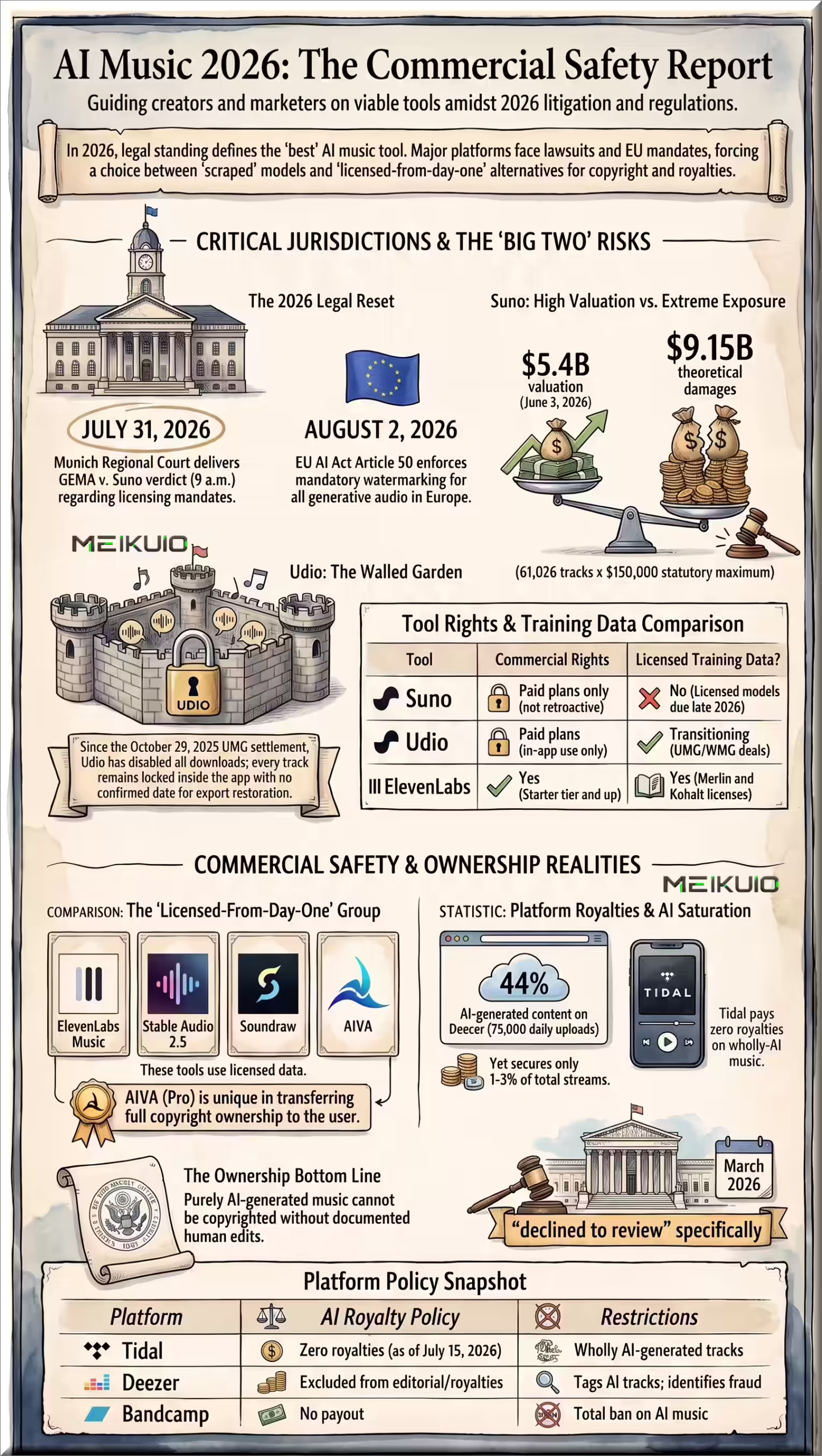
July 31, 2026. The Munich Regional Court reads its verdict in GEMA v. Suno at 9 a.m. The German collecting society played Suno’s output next to Forever Young, Mambo No. 5, Daddy Cool and three other classics in court and argued the results were confusingly similar. The same court already ruled against OpenAI in November 2025 on lyric memorization. If GEMA wins, it becomes the first major European ruling that AI music companies must license the catalogs they train on.
August 2, 2026. Article 50 of the EU AI Act becomes enforceable. Every generative audio platform serving Europe must embed machine-readable watermarks in its output. Anonymous AI music effectively ends there.
The American cases will take longer. In Boston, where UMG and Sony want to expand their suit against Suno to 61,026 identified recordings, the court has pushed dispositive motions to April 2027, so a real fair use ruling lands in late 2027 at the earliest. The number to remember: at the statutory maximum of $150,000 per work, Suno’s theoretical exposure is $9.15 billion.
Investors looked at that number and shrugged. On June 3, 2026, Suno closed a $400 million round at a $5.4 billion valuation, more than double what it was worth seven months earlier.
Funding valuations and maximum damages exposure are different financial concepts, labelled separately. Exposure is theoretical: 61,026 works times the statutory maximum of 150,000 USD per work, rounded in the original graphic to 9.15B; it is not a judgment or an actual liability.
Suno: The Best Songs, on a Lease
Suno is still the tool to beat for complete songs. The v5.5 model, out since March 26, 2026, produces vocals with breath sounds, vibrato and phrasing that fool most listeners, and Suno Studio has grown into a real browser DAW with stem separation into up to 12 WAV tracks, warp markers and voice personas you can train on your own recordings. Around 7 million tracks get generated on it every day. The company reports over 100 million people have tried it and about 2 million pay.
Pricing is simple. Free gets you 50 credits a day, roughly ten songs, on the older v4.5-all model, strictly non-commercial. Pro at $10 a month buys 2,500 credits and commercial use rights. Premier at $30 adds 10,000 credits and Studio. If you’re weighing that against what you already spend on AI subscriptions, our AI pricing comparison tool puts it side by side with ChatGPT, Claude and the rest.
I signed up for the free plan in mid-July 2026 to check what it actually hands over now, because the terms have been shifting under the Warner deal. Two things stood out. My prompt generated full tracks on v4.5-all, but the same prompt on v5.5 produced a 47-second preview locked behind an Upgrade for full song button. And there is no download anywhere on the free plan anymore. Play, like, share. That’s it. The play-and-share-only free tier was announced as a 2026 change; as of this month it’s simply how Suno works.
Now the part the other rankings skip. Suno’s terms used to say you own the songs. After the Warner Music settlement in November 2025, the language flipped. Songs made on the free plan belong to Suno, full stop. Paid subscribers get commercial rights assigned to them, but the current policy language states that even then you generally are not considered the owner of the songs. And the rights only cover tracks generated while your subscription was active. Subscribing later doesn’t rescue songs you made on free.
Note
Commercial rights on Suno are not retroactive. A song made on the free plan stays non-commercial forever, even if you upgrade the next day. If a track might earn money later, generate it while paying, and keep the receipt and the generation date.
The Warner deal also commits Suno to launching licensed models in late 2026 and retiring the current ones, which were trained on scraped audio. One court filing detail says a lot about that era: Suno spent over $32 million on computing power and about $2,000 on data.
We’ve become the Ozempic of the music industry. It’s like everybody’s on it and nobody wants to talk about it.
Mikey Shulman, Suno CEO, Forbes, April 2026
Udio: Great Audio You Can’t Take Home
Udio, built by ex-Google DeepMind researchers, has long been the producer’s pick. Cleaner frequency separation than Suno, stronger jazz and orchestral output, inpainting that regenerates just the 30 seconds you highlight, and tracks that hold together for up to ten minutes.
None of that is the story anymore. When Udio settled with Universal Music Group on October 29, 2025, it turned off downloads. Audio, stems, video, all of it. Users got a 48-hour window in early November to export their libraries, and since then every track made on Udio lives inside Udio. You can generate, listen and share within the app. You cannot take the file. CEO Andrew Sanchez didn’t sugarcoat it: “we hate the fact we cannot offer downloads right now.” The licensed platform that’s supposed to restore exports is promised for 2026 with no confirmed date.
I checked this myself in July 2026. Six tracks generated on the free tier in one sitting, from a cinematic score to power pop, all sitting playable in my library, all locked inside it. I went looking for the download button the way you look for your keys in a coat you already checked twice. It isn’t hidden. It’s gone.
Subscriptions still cost real money in the meantime. Standard at $10 gets 2,400 monthly credits, Pro at $30 gets 6,000. My advice is blunt: if your workflow ends with a file on your hard drive, don’t pay for Udio this month. Watch for the relaunch instead. The relaunch does have upside, since UMG, Warner, Merlin and Kobalt have all signed licensing deals with Udio, meaning the rebuilt product will be one of the most legally solid in the category. Today it’s a beautiful walled garden.
Suno vs Udio: The Head-to-Head Everyone Asks About
On pure sound, the split hasn’t changed. Suno v5.5 wins vocal-driven pop, R&B and rock, with more believable singers and better adherence to lyric structure tags. Udio wins instrument-driven work: its drums have more transient snap, its orchestral pieces breathe, and its editing tools are more surgical. Producers on both platforms complain about a glossy sameness creeping into recent models, and some Suno users report v5.5 feels less organic than v5 after safety updates tied to the litigation.
For this review I fed the identical indie-rock prompt to both free tiers. Both delivered complete, structured songs in about two minutes. Hear them for yourself, straight from each platform’s own player.
Both experiments ended the same way: with music I could listen to and couldn’t keep. In 2026 the comparison is settled by logistics, not sound. Suno gives paying users a file they can use commercially for $10. Udio gives everyone a stream inside its own app. Until the licensed Udio relaunches with exports, Suno wins by forfeit.
The Licensed-From-Day-One Crowd
Four platforms never scraped the open internet, and their sales teams want you to know it. Agencies, game studios and film producers have been drifting here all year because the legal chain of custody is clean.
ElevenLabs Music: the safe default for songs with vocals
Launched August 5, 2025 with licensing deals from Merlin and Kobalt already signed, which covers a huge share of the independent catalog. The Music v2 model handles vocals, composition and multiple languages in one pass, and it can flip genres mid-track. Starter at $5 a month includes limited commercial use; Creator at $22 clears full commercial rights. When the distributor Believe started blocking uploads from unlicensed AI platforms in April 2026, ElevenLabs tracks stayed distributable. That’s the practical difference a license makes.
Stable Audio 2.5: loops and sound design, clean data
Stability AI trained it on the licensed AudioSparx library. No real vocals, up to six minutes, excellent textures and transitions for video work. Pro at $11.99 a month carries a Creator License for commercial distribution, and there’s an API for pipelines.
Soundraw: background music with a license that outlives you canceling
Everything is generated from in-house recorded material, and the license is perpetual: tracks you downloaded stay cleared for YouTube, podcasts and client work even after your subscription ends. No prompts, just parameter sliders and an energy curve you drag around. Creator costs $11.04 a month billed annually. The catch: no stems until the pricier Artist tiers, and no vocals at all.
AIVA: the only one that hands you the copyright
AIVA generates classical and cinematic scores as MIDI, trained on 30,000+ classical works, and exports sheet music. On the Pro plan, around €33 a month billed annually, AIVA transfers full copyright ownership of the composition to you. No other major platform does that. For film composers and game studios that need to own what they ship, this is the strongest legal offer in the entire category.
The Wildcards
Mureka: the producer’s toolbox with an asterisk
Mureka, built on Kunlun Tech’s SkyMusic models, plans a song’s structure before generating it, lets you hum a melody and build a full arrangement around it, and exports WAV, stems and MIDI together, which almost nobody else offers at $9 a month. Two caveats: it faces its own US training-data lawsuit, and video exports carry a watermark even on paid plans.
Producer.ai: the one Google just bought
Remember Riffusion, the open-source experiment that generated music from spectrogram images? It rebranded to Producer.ai in mid-2025, built a chat-style agent around its FUZZ model, hit a million monthly users, and on February 24, 2026 Google bought the company. The team joined Google DeepMind and the product now runs Lyria 3 under the hood, with a free tier and paid plans from $6. It’s the strongest free playground on this list, and a signal of where things are heading: big tech would rather buy a licensed-and-tidy music app than untangle a scraped one. Google is clearly assembling a creative stack around Gemini, the same ecosystem we covered in our ChatGPT alternatives guide.
Boomy and Musicfy: the quick and the niche
Boomy remains the fastest route from nothing to a track on Spotify, with 21 million songs created and a built-in distribution pipeline, though full commercial rights only arrive on the $29.99 Pro tier. Musicfy is really a voice tool: clone a voice, sing a melody and have it come out as a saxophone. Useful, narrow, from $9.99.
Will Anyone Even Hear It? Platform Rules in 2026
Making the track is half the battle. Getting it heard is the other half, and the streaming platforms spent the past year building filters.
On Deezer, 44 % of all daily uploads are now fully AI-generated, about 75,000 tracks every day. They collect 1 to 3 percent of streams. Almost half the supply, almost none of the demand.
Tracks per day. April: 44% of uploads but only 1–3% of streams. These percentages have different denominators and are not additional track-count observations.
The rest of the field lines up like this. Spotify allows disclosed AI music and shows AI credits in the app through the DDEX standard, launched in beta with DistroKid in April 2026, but it removed over 75 million spam tracks in a year and bans unauthorized voice clones. Deezer tags AI tracks, keeps them out of recommendations and editorial playlists, and found that up to 85 percent of streams on fully AI tracks were fraudulent, so it excludes them from royalties. Apple Music added Transparency Tags in March 2026; its own numbers say over a third of new uploads are fully AI while such music gets under half a percent of listening. YouTube requires a synthetic-content label and has demonetized around 40 percent of faceless AI music channels, while also giving creators a Replace Song button that swaps copyright-claimed audio for AI instrumentals. Tidal went furthest: from July 15, 2026 it pays no royalties at all on music it identifies as wholly AI-generated. Bandcamp bans AI music entirely.
And a distribution layer is forming above the stores. Believe, one of the biggest digital distributors, now scans uploads and blocks tracks from unlicensed platforms, naming Suno’s current models among them, while waving through licensed ones like ElevenLabs and the incoming Udio. Where you generated a song is becoming metadata that follows the file.
Do You Even Own What You Make?
Short answer for the US: not really, not from prompts alone. The Copyright Office’s January 2025 report says machine-determined expression can’t be copyrighted, and the Supreme Court declined to revisit the question in March 2026. A track that’s 100 percent AI output is effectively public domain. Anyone can copy it, and you can’t stop them. What the platforms sell you on paid plans is a contractual right to use and monetize the track, which is real and useful, but it isn’t a copyright.
The fix is human input you can document. Re-record the vocal, rearrange the structure, play the bassline yourself, keep dated project files. Registrars and distributors increasingly ask for exactly that evidence, the same way schools now run essays through detection tools, a mess we dug into in our AI humanizer reality check. Pure output is a demo. Your edit is the song.
FAQ
Can you use Suno songs commercially?
Yes, if the song was generated while you had an active Pro or Premier subscription. Free-plan songs are non-commercial forever, and upgrading later doesn’t unlock them. Keep invoices and generation dates as proof.
Why can’t I download my songs from Udio?
Udio disabled all downloads after settling with Universal Music Group in October 2025. A 48-hour export window closed in early November 2025. Downloads are expected to return with the licensed platform Udio has promised for 2026, but no date is confirmed. We verified in July 2026: the button is still gone.
Do you own the copyright to AI-generated music?
In the US, no. Purely AI-generated output can’t be copyrighted regardless of which plan you pay for. Paid plans grant contractual commercial rights, which let you monetize the track but not stop others from copying it. Adding documented human work changes that.
What happens after the July 31 GEMA ruling?
If GEMA wins in Munich, AI music companies will likely need licenses for European catalogs, accelerating the shift to licensed models across the industry. Expect faster model retirements and possibly new limits for EU users. If Suno wins, the pressure eases but the US cases continue into 2027.
Can you monetize AI music on Spotify or YouTube?
Yes, with disclosure and commercial rights from a paid plan. Spotify accepts labeled AI music through DDEX credits, and YouTube allows it with the synthetic-content label. Tidal pays no royalties on fully AI tracks, and Bandcamp bans them outright.
Which AI music generator is fully licensed?
ElevenLabs Music, Stable Audio, Soundraw and AIVA were trained on licensed or in-house data from the start. Udio’s rebuilt platform will join them once it launches. Suno’s licensed models are promised for late 2026.
My Take
I’d run two subscriptions right now and neither is Udio. Suno Pro for anything with vocals, because the songs are simply better, generated only while paying, downloaded and backed up the same day. ElevenLabs or Soundraw for anything a client will ever touch, because clean training data means nobody sends you a takedown two years from now. And I’d set a calendar reminder for July 31. If Munich goes GEMA’s way, half the tools on this page will change their terms again, and this article will get its first update.