

Open Facebook in the US in 2026 and most of what you scroll past has nothing to do with your friends. By Meta’s own count, 41% of Feed views now come from accounts you’ve never followed, and 98.5% of everything you see carries no outside link at all. Facebook stopped being a place you keep up with people and became a machine that guesses what will hold your attention. Almost everything written about its algorithm this year splits into two piles: things Meta actually confirmed, and things marketing blogs invented and dressed up as fact. Here’s the honest split, with the numbers and the sources.
- The Quick Verdict
- How Facebook ranks your feed in 2026
- What Meta actually changed in 2026 (Confirmed)
- What’s Contested (blogs say it, Meta didn’t)
- What’s a Myth (debunked)
- What this means if you post on Facebook
- Frequently Asked Questions
- Why did my Page’s reach suddenly drop without any policy violation?
- Does Facebook really suppress posts with external links?
- Is there a best time to post on Facebook in 2026?
- Will asking people to like or share help my post?
- Are Reels the only way to get reach on Facebook now?
- Is there a Facebook shadowban?
- My Take
The Quick Verdict
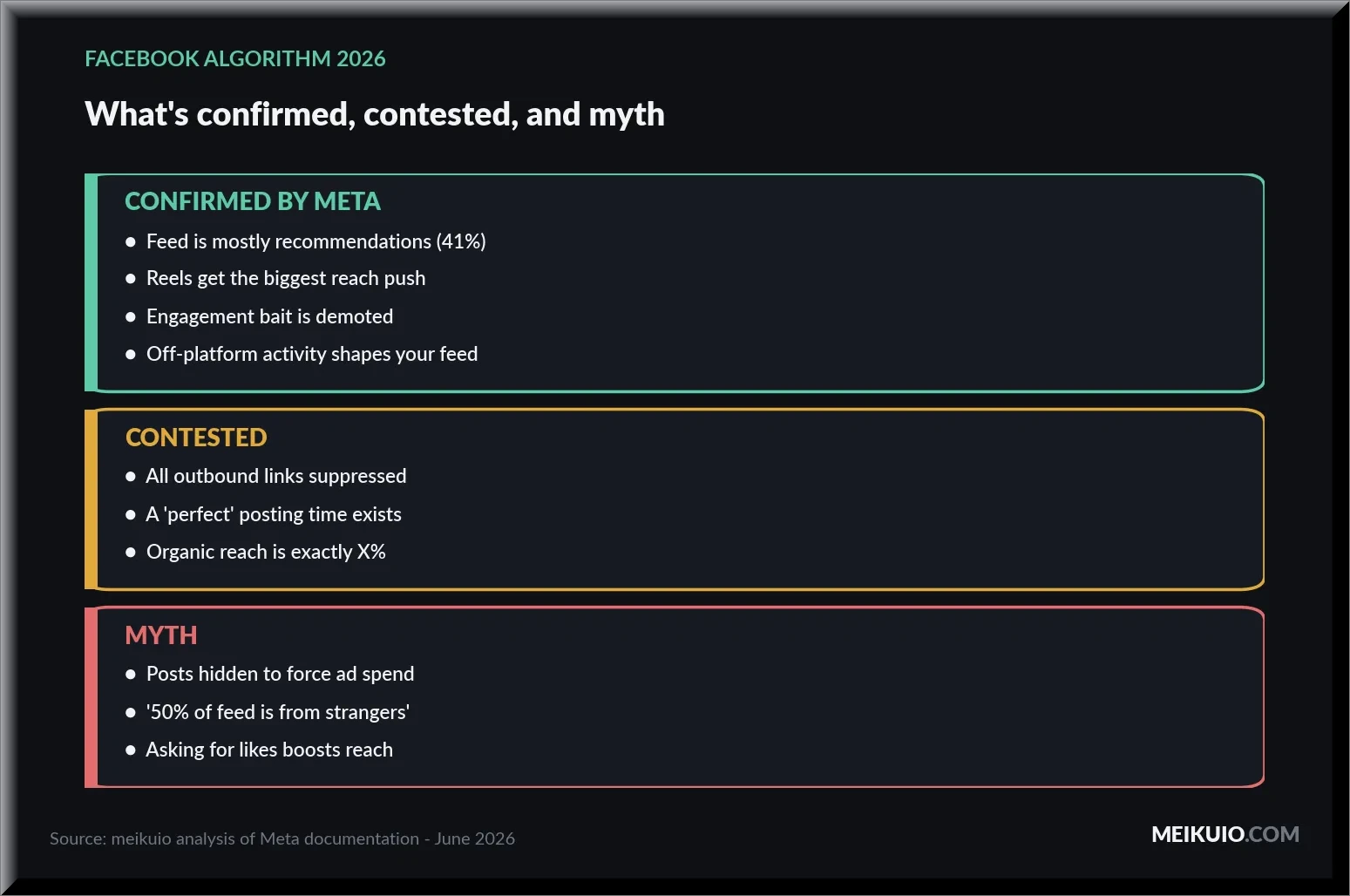
Here’s where the most-repeated 2026 claims actually stand. Green is confirmed by Meta on the record. Yellow is circulating but unconfirmed or oversimplified. Red is debunked.
How Facebook ranks your feed in 2026
Strip away the jargon and the Facebook algorithm runs the same four steps it always has, just with far more powerful models behind each one. Meta lays it out in its own documentation as inventory, signals, predictions, and a relevance score.
First comes inventory: every post that could appear, from friends, Pages, Groups, ads, and recommended accounts you don’t follow. Then signals, the raw facts about each post and your situation: who posted it, when, what type it is, your device, your connection speed, the time of day. Next, predictions, where the heavy lifting happens. Meta runs over 100 prediction models at once, estimating how likely you are to comment, share, watch a video to completion, or say you found a post worthwhile. Finally those predictions collapse into a single relevance score, which Meta describes as its “best guess at how meaningful you will find this story.” The higher the score, the higher the post sits.
The scale is the part most guides skip. Facebook isn’t ranking a handful of posts. A lightweight model first narrows trillions of eligible posts down to roughly 500 candidates per feed load, and only then do the heavier models score and order those 500. Everything you scroll is the output of that two-stage filter, recalculated every time you open the app.
Note
There is no single ‘Facebook algorithm.’ Feed, Reels, Groups, and Search each run their own ranking models with different weights. When someone says ‘the algorithm changed,’ ask which surface they mean. The other big apps are split the same way, as our guide to social media algorithms shows platform by platform.
What Meta actually changed in 2026 (Confirmed)
Meta rarely hands creators a changelog, but in 2025 and 2026 it confirmed several shifts in writing. These are the ones with a name and a date attached.
More Read

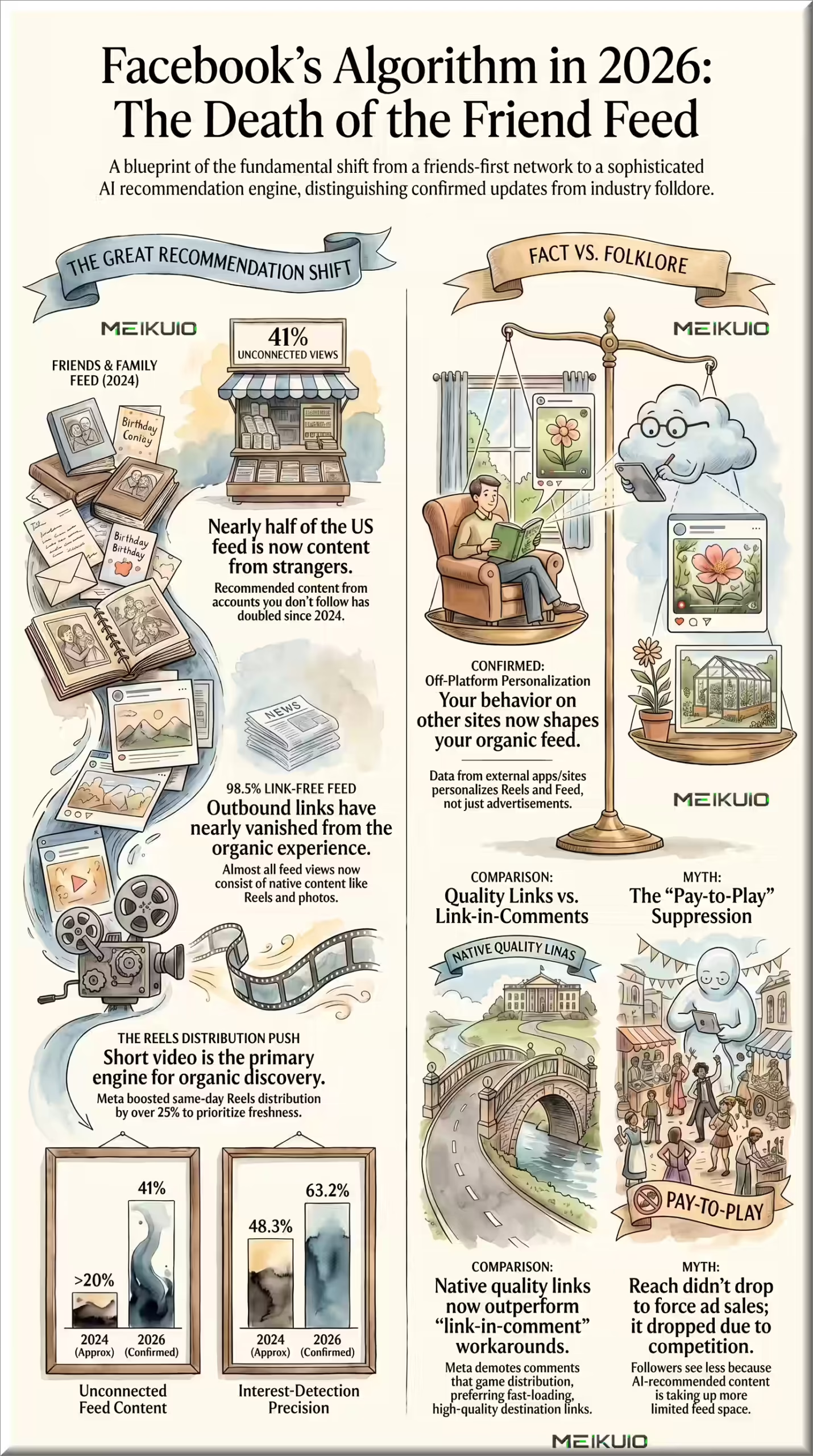
The feed is now mostly recommendations. In its Widely Viewed Content Report for Q4 2025, Meta broke down where US Feed views come from: 46.8% from friends, Groups you’ve joined, and Pages you follow, and 41% from “unconnected” accounts the system thinks you’ll like. The remaining 12.2% is odds and ends like Events. Two years earlier, Mark Zuckerberg put unconnected content at “more than 20%” of the feed. It’s roughly doubled since. The follower-first feed is gone, and it isn’t coming back.
These are measured shares of Feed views and total 100%; not shares of accounts or posts.
Reels got a deliberate distribution boost. In a January 2026 Newsroom post, Meta said its Q4 2025 feed and video ranking improvements delivered a 7% lift in views of organic feed and video posts, with video time spent up double digits year over year in the US. In the same post it confirmed Facebook was surfacing over 25% more same-day Reels than in Q3 2025. Layer on the June 2025 change that renamed the Videos tab to Reels and routed all uploaded video into that surface, and the direction is unmistakable: short video is where organic reach lives now.
Offline model evaluation percentages, not a creator reach guarantee. Exact before/after metrics from the original graphic.
The single biggest 2026 shift: 41% of what Americans see on Facebook now comes from accounts they don’t follow. Your reach is earned per post, not handed to you by your follower count.
What you do off Facebook now shapes what you see on it. This one is barely two weeks old. On June 9, 2026, Meta announced that starting in July, data businesses already share with it about your activity on other sites and apps will personalize your organic Feed, Reels, and AI responses, not just your ads. Buy a tent online and you may start seeing camping Reels. Meta says it’s collecting no new data, only using existing signals more broadly, and the change rolls out across the US, UK, Brazil, and several other countries. For reach, it means relevance is now partly decided by behavior that never happened on the platform at all. It’s the same recommendation-first logic reshaping every major platform right now, from the Instagram algorithm in 2026 to the way YouTube ranks video and the short-form discovery engine powering TikTok’s 2026 algorithm. X goes further and publishes the code behind its feed, as our breakdown of the X algorithm in 2026 shows.
Engagement bait stays demoted. This isn’t new, but it’s still enforced and still misunderstood. Meta demotes posts from accounts, Pages, and publishers that repeatedly use engagement bait to game reach. Its 2017 announcement, still the clearest official wording, said it would begin “demoting individual posts from people and Pages that use engagement bait” and apply “stricter demotions for Pages that systematically and repeatedly” do it. A separate distribution page, updated in July 2025, confirms Meta “may reduce the distribution of ‘borderline’ content.” The policy is alive in 2026.
What’s Contested (blogs say it, Meta didn’t)
This is where most of the year’s noise sits. None of the below is flatly false, but none of it came from Meta in the confident, numeric form you’ll see it quoted in.
“Facebook suppresses all your outbound links.” The reality is more interesting than the myth. Meta has never banned links outright, but its own Q4 2025 data shows 98.5% of US Feed views were on posts with no external link, and just 1.5% included one, usually from a Page the viewer already follows. So links genuinely are rare in the feed, but not because of a hidden penalty on everyone. Meta’s published guidelines demote links to slow-loading pages, cloaking domains, and ad-heavy clickbait, not clean links to good destinations. And in a twist almost no one saw coming, multiple outlets reported Facebook referral traffic to some publishers roughly quadrupled by March 2026 after Meta let political and news content back into feeds. The honest read: low-quality link posts are throttled, quality ones aren’t, and the feed is link-light by design rather than by ban.
Meta never banned links. But 98.5% of US Feed views in late 2025 carried no outside link at all.
“There’s a perfect posting time the algorithm rewards.” For standard Feed posts, this is mostly a myth. The feed is personalized and non-chronological, so a relevance score, not a clock, decides what surfaces. The “best times to post” charts from tools like Sprout Social measure when people are online and active, not a ranking bonus baked into the algorithm. The one real exception is Reels, where Meta’s confirmed same-day boost means a fresh video does have a short window of extra distribution. So timing matters for Reels and barely registers for a text or photo post.
“Organic reach is X% now.” You’ll see a precise figure quoted, often around 1 to 2% or “2 to 5% of followers.” Treat all of these as estimates, because Meta publishes no official organic-reach benchmark for Pages. Third-party analytics vendors put average Page reach somewhere between roughly 1.4% and 6% of followers depending on the dataset, niche, and post format, with video and Live generally reaching more than plain photos. The trend is real and reach is low, but anyone quoting a single decimal as the universal number is guessing with confidence.
“Putting the link in the first comment protects your reach.” This was a reliable workaround for years, and in 2026 it’s genuinely contested. Meta’s ranking looks at a post’s whole engagement profile, comment section included, and it runs classifiers that demote comments full of spam or promotional links. Repeatedly steering people to “link in comments” can read as distribution gaming. With quality links no longer carrying a blanket penalty, a clean native link post to a fast, legitimate page is now often the safer bet than the comment trick.
What’s a Myth (debunked)
Drop these entirely. They push you to do the wrong things.
- “Facebook hides your posts from followers to force you to pay for ads.” Reach to followers did collapse, but the cause is structural, not punitive. When 41% of the feed is handed to recommended content, there’s simply less room for posts from Pages people follow. You earn reach per post through strong signals now, not through a follower count, and not by buying your way past a deliberate block.
- “50% of your feed comes from strangers.” Close enough to feel true, wrong on the detail. Meta’s measured figure is 41% of views from unconnected accounts in the US for Q4 2025, not a round half. The number matters because it’s real, and because rounding it up is exactly the kind of folklore this piece exists to correct.
- “Asking for comments or shares boosts your post.” The opposite. “Comment YES if you agree” and “tag three friends” are textbook engagement bait, and Meta demotes posts and Pages that lean on them. Genuine questions that spark real conversation help; transparent bait gets throttled.
- “Going Live guarantees a reach boost.” Live video does tend to draw more real-time interaction, which can lift a stream, but there’s no automatic, unconditional boost. Static-image or looped “live” streams that try to game the format get demoted like any other low-quality content.
If you manage Pages across networks, it’s worth seeing how differently each one handles reach. The professional feed plays by its own rules, as our breakdown of the LinkedIn algorithm in 2026 shows, even though the underlying shift toward recommendations is the same everywhere.
Facebook isn’t gatekeeping your posts to sell you ads. It gave the feed’s space to recommendations, and now reach is something every post has to earn on its own.
What this means if you post on Facebook
Strip away the noise and the 2026 playbook is short.
- Treat Reels as your discovery engine. Short video is the format Meta is actively pushing into unconnected feeds, and it’s the clearest path to people who don’t follow you yet.
- Make things worth saving and sending. Saves and shares to Messenger or WhatsApp are among the strongest signals that a post deserves wider distribution, far more than a one-tap like.
- Post original work. Meta’s recommendation systems bury recycled clips, watermarked reposts, and low-effort edits of other people’s footage. Your own voice and footage are a ranking edge.
- If you link out, link to something fast and legitimate. The penalty is on slow, cloaked, ad-stuffed pages, not on quality destinations.
- Stop chasing the “perfect” posting time for normal posts. Spend that energy on the first three seconds of a Reel instead, where attention is actually won or lost. If you publish across multiple brands, using the best social media scheduler helps streamline your cross-platform video and carousel calendar without manual upload friction.
Field notes
- Unconnected distribution: 41% of US Feed views come from unconnected recommendations (Meta WVCR Q4 2025).
- Link metrics: 98.5% of US Feed views are on link-free posts; legitimate outbound links face no automatic penalty.
- Reels acceleration: Over 25% more same-day Reels surfaced in Q4 2025; all video consolidated into Reels surface.
- Cross-app personalization: Off-platform web browsing activity shapes organic Feed and Reels starting July 2026.
- Enforcement rules: Systematic engagement bait and unoriginal content reposts are actively throttled.
- Sources: Meta Widely Viewed Content Report (Q4 2025), Meta Newsroom (Jan/June 2026), Meta Transparency Center.
Frequently Asked Questions
Why did my Page’s reach suddenly drop without any policy violation?
A sudden drop while your account status stays green is usually an algorithmic demotion, not a shadowban or a glitch. The most common trigger in 2026 is content flagged as unoriginal: reposting video or images you didn’t create, or making only minor edits like adding borders, captions, or speed changes to someone else’s footage. That flag can limit a Page’s distribution to its existing followers and cut it out of recommendations. Posting original material is the fix.
Does Facebook really suppress posts with external links?
There’s no blanket ban, but the feed is overwhelmingly link-free: 98.5% of US Feed views in Q4 2025 were on posts with no outside link. Meta demotes links to slow, cloaking, or ad-heavy pages, not clean links to good destinations. In fact, referral traffic to some publishers rose sharply in early 2026. Link to a fast, legitimate page and you’re fine; the throttling targets low-quality destinations.
Is there a best time to post on Facebook in 2026?
For standard Feed posts, not really. The feed is personalized and ranked by relevance, not by how recently you posted, so there’s no hidden bonus for hitting a magic hour. ‘Best time’ charts show when your audience is online, which helps early engagement, but it isn’t a ranking lever. The exception is Reels, which get a confirmed same-day freshness boost, so timing matters more for short video.
Will asking people to like or share help my post?
No, and it can hurt. Phrases like ‘like if you agree’ or ‘tag a friend’ are engagement bait, and Meta demotes posts and Pages that repeatedly use them. What does help is content that earns genuine interaction, especially saves and private shares to Messenger or WhatsApp, which signal real value. Ask a real question if you want comments; don’t fish for reactions.
Are Reels the only way to get reach on Facebook now?
Not the only way, but the strongest. Meta is actively pushing Reels into the feeds of people who don’t follow you, surfacing 25% more same-day Reels in late 2025 and routing all video through the Reels surface. Photos, text posts, and carousels still reach your existing audience and can drive deep engagement, but short video is the clearest path to new viewers in 2026.
Is there a Facebook shadowban?
Not in the mysterious sense people mean. Facebook doesn’t secretly mute accounts at random, but it does make content ‘ineligible for recommendation’ when it breaks community or recommendation guidelines, and it demotes engagement bait, unoriginal content, and borderline material. Those are documented, measurable penalties. If your reach tanked, look for an unoriginal-content flag or a guideline issue before blaming a phantom ban.
My Take
The most useful thing I can tell you about Facebook in 2026 is to stop treating it as a social network and start treating it as a recommendation engine that happens to have your friends in it. The 41% number is the whole story in one statistic: the feed belongs to content the system predicts you’ll like, not to people you chose to follow. That sounds bleak for Pages, but it’s actually the most level playing field Facebook has offered in years, because a strong post can now reach strangers regardless of how many followers you have. Make something people are glad they watched, make it yours, and make the first few seconds count. The folklore about magic posting times and link penalties is just noise from people guessing at a system Meta has, for once, described in plain numbers.