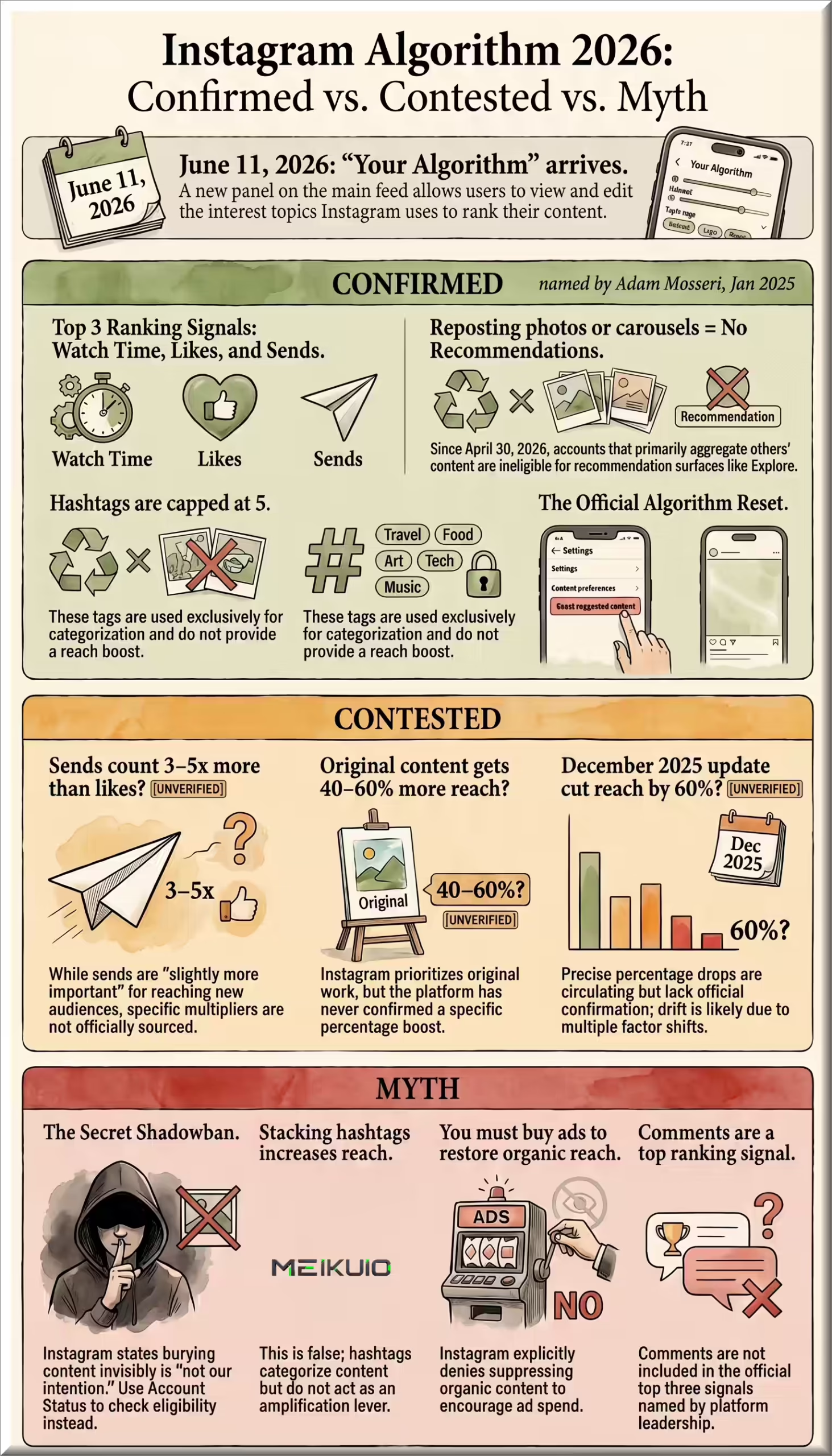



On June 11, 2026, Instagram put a panel called “Your Algorithm” on the main feed, letting anyone see the interest topics it thinks they like and edit them on the spot. It’s the clearest signal yet of where Instagram is heading: less black box, more dials you control. Yet most “2026 algorithm rules” floating around right now were never confirmed by Instagram at all. Some are real. Some are guesses dressed up as numbers. A few are flat wrong.
- The 60-second version
- There is no single Instagram algorithm
- What Instagram actually confirmed
- The top three signals: watch time, likes, sends
- Reposting other people’s content now costs you reach
- Hashtags are capped at 5, and they were never the lever you thought
- You can reset your algorithm: officially
- Trial Reels let you test on strangers first
- “Your Algorithm”: the dials are now on your feed
- Mosseri’s year-end memo: the polished feed is over
- What’s contested: the numbers nobody can source
- “Sends count 3 – 5x more than likes”
- “Original content gets 40 – 60% more distribution”
- “The December 2025 update dropped reach by 60%”
- “AI content is being downranked”
- “The average engagement rate is X%”
- What’s myth: the stuff primary sources contradict
- The secret shadowban
- “Stack hashtags to boost reach”
- “You have to buy ads to get your reach back”
- “Comments are a top ranking signal”
- “Reposting viral content grows your account”
- How to actually work with it in 2026
- Frequently Asked Questions
I went through every major claim circulating about the 2026 Instagram algorithm and checked each one against primary sources: Adam Mosseri’s own videos and memos, Meta’s newsroom, Instagram’s ranking documentation, and the reporting that quotes them directly. Then I sorted everything into three buckets. Confirmed means a primary source backs it. Contested means it’s repeated everywhere but no official source supports the specific number. Myth means a primary source contradicts it outright. This is the same approach that worked for our breakdown of LinkedIn’s 2026 algorithm, where half the “rules” turned out to be guesswork too, and for the X algorithm, where we checked the claims against X’s published code.
The 60-second version
There is no single Instagram algorithm
Start here, because almost every bad take downstream comes from missing it. Feed, Stories, Explore, Reels, and Search each run their own ranking system, tuned to how people use that part of the app. A signal that matters in Reels can be irrelevant in Stories. When a guide tells you “the Instagram algorithm rewards X,” ask which surface it means, because the honest answer is usually “it depends.”
In the main feed, ranking leans on your recent activity, details about the post, details about who posted it, and your history of interacting with that person. Stories weight viewing history and how close you are to the account. Explore and Reels behave differently again, leaning hard on how popular a post is and how likely the system predicts you are to interact with it. That’s why a reel can reach strangers while your feed posts mostly reach followers. Different surface, different math. The same surface-by-surface logic drives LinkedIn’s feed, Facebook’s 2026 recommendation shift follows the same unconnected distribution math, and YouTube’s 2026 algorithm splits Shorts from long-form the very same way. It trips up the same people every time.
More Read

What Instagram actually confirmed
The top three signals: watch time, likes, sends
In a January 2025 video, Mosseri named them directly: “The top three signals that matter most for ranking are watch time, likes and sends. So when looking at your insights, pay close attention to average watch time, likes per reach, and sends per reach.” He added a wrinkle worth remembering: “Likes are slightly more important for connected content, and sends are slightly more important for unconnected content.” With people who already follow you, a like carries a bit more weight. With strangers, a share matters more.
Notice what’s missing from that list. Comments. They’re not in the official top three, which quietly kills one of the most repeated pieces of creator advice. More on that below.

Reposting other people’s content now costs you reach
On April 30, 2026, Instagram extended its originality crackdown to photos and carousels. Reels aggregators had already been hit back in 2024. Now accounts that mostly repost other people’s photos and carousels are no longer eligible for recommendations anywhere in the app, including feed recommendations and the Discover tab. Your followers still see your posts. Strangers, through recommendations, won’t.
The line between “original” and “aggregated” is the part people get wrong. Slapping a watermark on someone’s clip, changing the speed, or screenshotting a post with credit does not count as original. What counts is materially making it yours: your own footage, a real edit, a voiceover, a take that wasn’t there before. Instagram’s own framing, reported by TechCrunch: “The best meme creators take third-party content and make it unmistakably theirs by layering in a perspective, joke, or context that wasn’t there before. This is the kind of creativity we want to continue rewarding.” If your growth plan was “repost viral reels,” 2026 ended it.
Hashtags are capped at 5, and they were never the lever you thought
In December 2025, Instagram’s @creators account confirmed the limit: posts and reels gradually moved to a maximum of five hashtags. Their reasoning was that “using fewer (up to 5) more targeted hashtags, rather than many generic ones, can improve both your content’s performance and people’s experience on Instagram.”
The cap matters less than what Mosseri had already said about what hashtags do. In early 2025 he was blunt that piling on hashtags doesn’t increase reach. They help categorize a post and tell people what it’s about. They are not a distribution hack, and they stopped being one long before the five-tag limit made the point unavoidable.
You can reset your algorithm: officially
This is real, it’s official, and it’s underused. Instagram’s Recommendations Reset, announced in late 2024 and broadly available through 2025, wipes your recommendation history across Explore, Reels, and Feed so the system relearns your interests from scratch. The path: Settings → Content preferences → Reset suggested content. During the reset you can also review and unfollow accounts. If your Explore tab has drifted somewhere you don’t recognize, this is the fix, not a “shadowban appeal.” For how resets and time-ordered views work on the other big apps, see our guide to social media algorithms.
Trial Reels let you test on strangers first
Launched in December 2024 for public accounts with 1,000+ followers, Trial Reels show a reel to non-followers first. Roughly 24 hours later you see how it did, then decide whether to release it to your own followers. Instagram’s own numbers: 40% of creators who try Trial Reels go on to post more reels, and 80% of those see increased reach with non-followers. Scheduling for trial reels arrived in February 2026. This mirrors how TikTok’s 2026 algorithm tests content in isolated batches with non-followers before scaling distribution. It’s the closest thing Instagram offers to a free A/B test, and most people who could use it don’t.
“Your Algorithm”: the dials are now on your feed
This is the freshest piece and the reason the timing matters. Your Algorithm started as a Reels test in October 2025, launched officially in the US on December 10, 2025, reached Explore in April 2026, and landed on the main feed on June 11, 2026. It shows the interest topics Instagram has tagged you with, lets you add or remove them, tune how prominent each one is, and even share your algorithm to Stories. Mosseri’s pitch for why it exists: “The system learns from what you tap, watch, and share, but you don’t really get to tell it what you want.” Now you can. No ranking guide currently sitting in Google’s top results even mentions this yet.
Mosseri’s year-end memo: the polished feed is over
On December 31, 2025, Mosseri published a long memo arguing that AI has made polish worthless. “Everything that made creators matter, the ability to be real, to connect, to have a voice that couldn’t be faked, is now suddenly accessible to anyone with the right tools,” he wrote, warning that “the feeds are starting to fill up with synthetic everything.” His prediction: the feed of perfectly composed square photos is dead, and raw, unflattering, obviously-human content becomes the new proof of authenticity. He floated cryptographic signing at the camera as a way to verify real media. This is a stated worldview from the head of Instagram, not a shipped ranking change. Hold that distinction, because the blogosphere already blurred it.
What’s contested: the numbers nobody can source
Here’s where most “2026 algorithm” articles quietly fail. They repeat precise-sounding figures with no link back to anyone official. The numbers feel authoritative because they’re specific. Specific isn’t the same as sourced.
“Sends count 3 – 5x more than likes”
This multiplier shows up across marketing blogs, usually attributed to a vague Mosseri “Q&A.” The actual quote only says sends are “slightly more important” for unconnected content. There is no 3x, no 5x, no published weighting anywhere in Instagram’s materials. Sends matter, that part is real. The exact multiplier is invented. Treat it as a directional hint, not a formula.
“Original content gets 40 – 60% more distribution”
Instagram confirmed the direction: original content is favored, aggregators are cut from recommendations. It never put a number on the boost. The 40 – 60% figure appears in no primary source. The direction is solid, the percentage is decoration.
“The December 2025 update dropped reach by 60%”
A lot of creators felt a dip around the new year and reached for a single villain. There’s no official confirmation of a 60% collapse, and benchmark data shows mild drift, not a cliff. The likelier explanation is a stack of smaller things landing at once: the five-hashtag cap, people actively retuning their feeds with Your Algorithm, and ordinary seasonal variance after the holidays. “My reach dropped” is real. “The December update cut it 60%” is a story built on top of it.
“AI content is being downranked”
Mosseri’s memo reads like a philosophy shift toward real human content, and plenty of outlets summarized it as “Instagram is prioritizing raw over AI.” But a worldview in a memo is not a ranking system in production. Labels for AI content exist. A documented, shipped penalty that demotes AI posts in ranking has not been announced. The vibe points one way; the confirmed mechanics don’t exist yet.
“The average engagement rate is X%”
Every benchmark study reports a different “average,” because they measure differently. Socialinsider’s Q1 2026 data, calculated by follower count, puts carousels around 0.52% and reels around 0.50%. Buffer, analyzing 52 million-plus posts with a reach-based method, lands at roughly 6.90% for carousels and 3.31% for reels. Both are credible. They’re just not measuring the same thing. Any article quoting a bare “the average Instagram engagement rate is X” without the methodology is selling certainty it doesn’t have.
What’s myth: the stuff primary sources contradict
The secret shadowban
The folklore version, an invisible, arbitrary punishment that silently buries everything you post, isn’t how it works. Instagram’s position is that limiting content invisibly “is not our intention,” and Account Status exists precisely so you can see whether your account or a specific post is eligible for recommendations, with an appeal path. What’s real is narrower: breaking the Recommendations Guidelines pulls you from recommendation surfaces, using automation or bot tools triggers genuine restrictions, and weak signals like low completion rate can suppress an individual post. The restriction is real, but it’s specific, visible in Account Status, and appealable. It’s not a curse.
“Stack hashtags to boost reach”
Dead twice over. Mosseri said repeatedly that hashtags don’t increase reach, and then the five-tag cap removed the option to test the old strategy at all. Hashtags categorize. They don’t amplify.
“You have to buy ads to get your reach back”
This one Instagram denies in writing, in the ranking explainer itself: “We don’t suppress content to encourage people to buy ads.” Organic reach rising and falling is not a shakedown to push you toward the ad account.
“Comments are a top ranking signal”
Mosseri’s stated top three are watch time, likes, and sends. Comments aren’t on it. They’re not worthless, and engagement that keeps people on a post can feed into watch time, but as a named ranking signal in 2026, comments simply aren’t the lever creators keep treating them as.
“Reposting viral content grows your account”
The exact opposite is now true. After April 30, 2026, aggregator accounts are cut from recommendations across the app. The repost-to-grow playbook didn’t just stop working, it became a liability.
How to actually work with it in 2026
Strip away the folklore and the real guidance is short. Make watch time your priority, because it’s the signal Instagram names first and the one comments quietly fold into. Post things people want to send to a friend, since sends do real work with strangers. Keep your content original in the way Instagram defines it: a real edit or a real take, not a reposted clip with your logo on it. Use up to five targeted hashtags and stop expecting them to carry reach. If you manage multiple accounts, handling Trial Reels and native scheduling alongside cross-platform distribution requires picking the best social media scheduler for your workflow rather than relying on manual uploads. And if your feed has drifted somewhere strange, reset it in Settings instead of blaming a phantom shadowban.
Field notes
- Top signals: average watch time, likes per reach, sends per reach (Mosseri, Jan 2025).
- Hashtag cap: 5 per post since December 2025; they categorize, they don’t boost reach.
- Reset path: Settings → Content preferences → Reset suggested content.
- Originality rule: since April 30, 2026, photo/carousel reposters lose recommendations app-wide.
- Quiet reach killers: watermarked, low-res, muted, mostly-text, or already-reposted reels.
- Trial Reels: test on non-followers first (public accounts, 1,000+ followers).
- Sources: Adam Mosseri announcements, Meta Newsroom, Instagram @creators, TechCrunch.
Frequently Asked Questions
How do I reset my Instagram algorithm?
Go to Settings → Content preferences → Reset suggested content. It clears your recommendation history across Explore, Reels, and Feed, and the system starts relearning your interests from your next interactions. It’s an official feature, not a workaround.
Why did my Instagram reach suddenly drop?
Usually it’s normal variance rather than a single update. Reach swings with how each post performs in its first hour, seasonal patterns, and changes you may have made yourself, like retuning topics in Your Algorithm. There’s no confirmed “60% reach drop” tied to any 2026 update. Check Account Status to rule out a real recommendation restriction.
Is the Instagram shadowban real?
Not in the secret, all-powerful sense people mean. Instagram can remove you from recommendation surfaces for guideline violations or bot-like behavior, and that’s visible in Account Status with an appeal option. A hidden, arbitrary ban on everything you post is folklore, not how the system works.
Do hashtags still work on Instagram in 2026?
They work to categorize a post and tell people what it’s about, not to boost reach. You’re capped at five, and Mosseri has said directly that more hashtags don’t increase distribution. Use a few targeted ones and don’t expect them to do the heavy lifting.
Do Trial Reels hurt your account if they flop?
No. A Trial Reel shows to non-followers first and doesn’t go to your followers unless you choose to release it, so a weak one stays low-stakes. Instagram’s data shows most creators who use the feature post more reels afterward and see better reach with non-followers.
Does posting time still matter?
Less than the old advice claims. Recent activity is a ranking signal, so posting when your audience is active gives a post an early nudge, but it won’t rescue content people don’t watch or share. Timing is a small edge, not a strategy.
Will AI-generated content be punished in 2026?
No shipped ranking penalty for AI content has been announced. Mosseri’s year-end memo signals a cultural shift toward raw, obviously-human posts, and AI labels exist, but a worldview in a memo isn’t the same as a ranking change in production. Watch this space rather than acting on it as settled fact.
Note
Specific isn’t the same as sourced.