

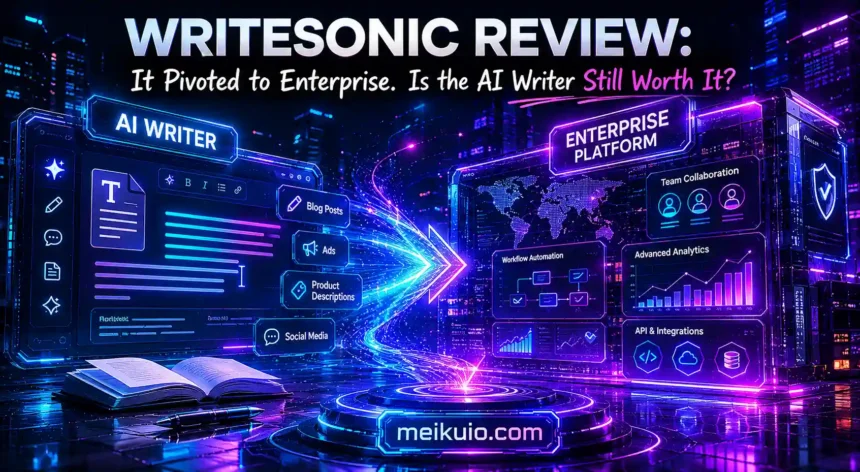

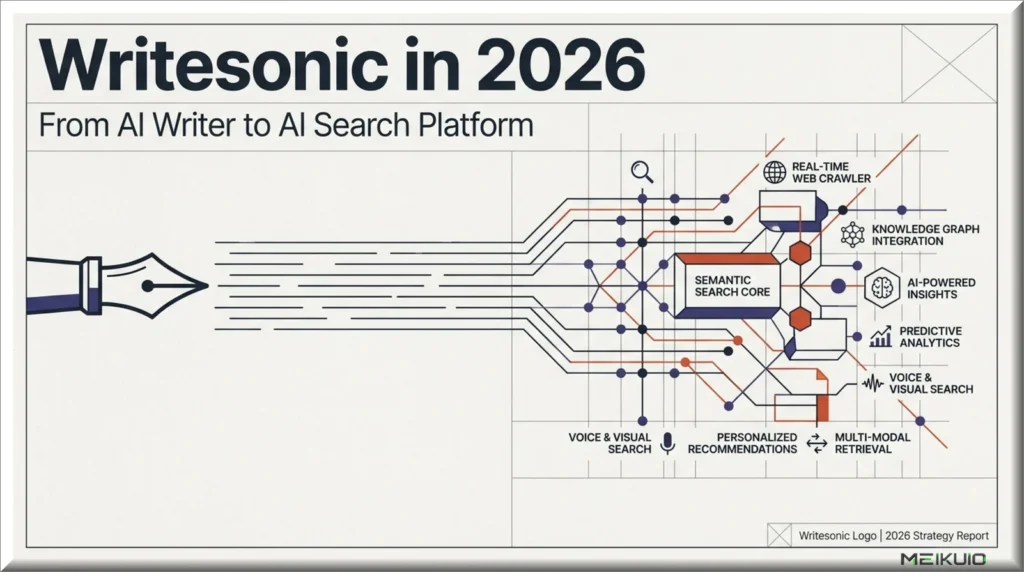
Writesonic is no longer the budget AI writer you remember. In 2026 it rebranded into an AI search visibility platform that tracks whether ChatGPT, Gemini, and Perplexity mention your brand, with plans starting at $79/month. The AI article writer still exists, but it’s now one feature buried inside an SEO suite, not the main product.
- Quick Verdict: What Writesonic Became
- What Writesonic Actually Does Now
- I Tested the Onboarding, and It Stumbled
- The Good and the Frustrating
- Should You Use Writesonic? A Quick Decision Guide
- Frequently Asked Questions
- Is Writesonic still an AI writer?
- How much does Writesonic cost in 2026?
- Does Writesonic have a free plan?
- Is Writesonic worth it for freelancers?
- What’s the difference between Writesonic and Jasper now?
- Can Writesonic track ChatGPT and Gemini mentions of my brand?
- My Take
If you came here looking for the cheap, ~$20/month tool Writesonic used to be, this review will save you some confusion. The Writesonic that competed with Jasper and Copy.ai has quietly become something else entirely. I spent an afternoon inside the current product to figure out what changed, what’s still good, and whether anyone in our audience, freelancers and small marketing teams, should still pay for it.
Quick Verdict: What Writesonic Became
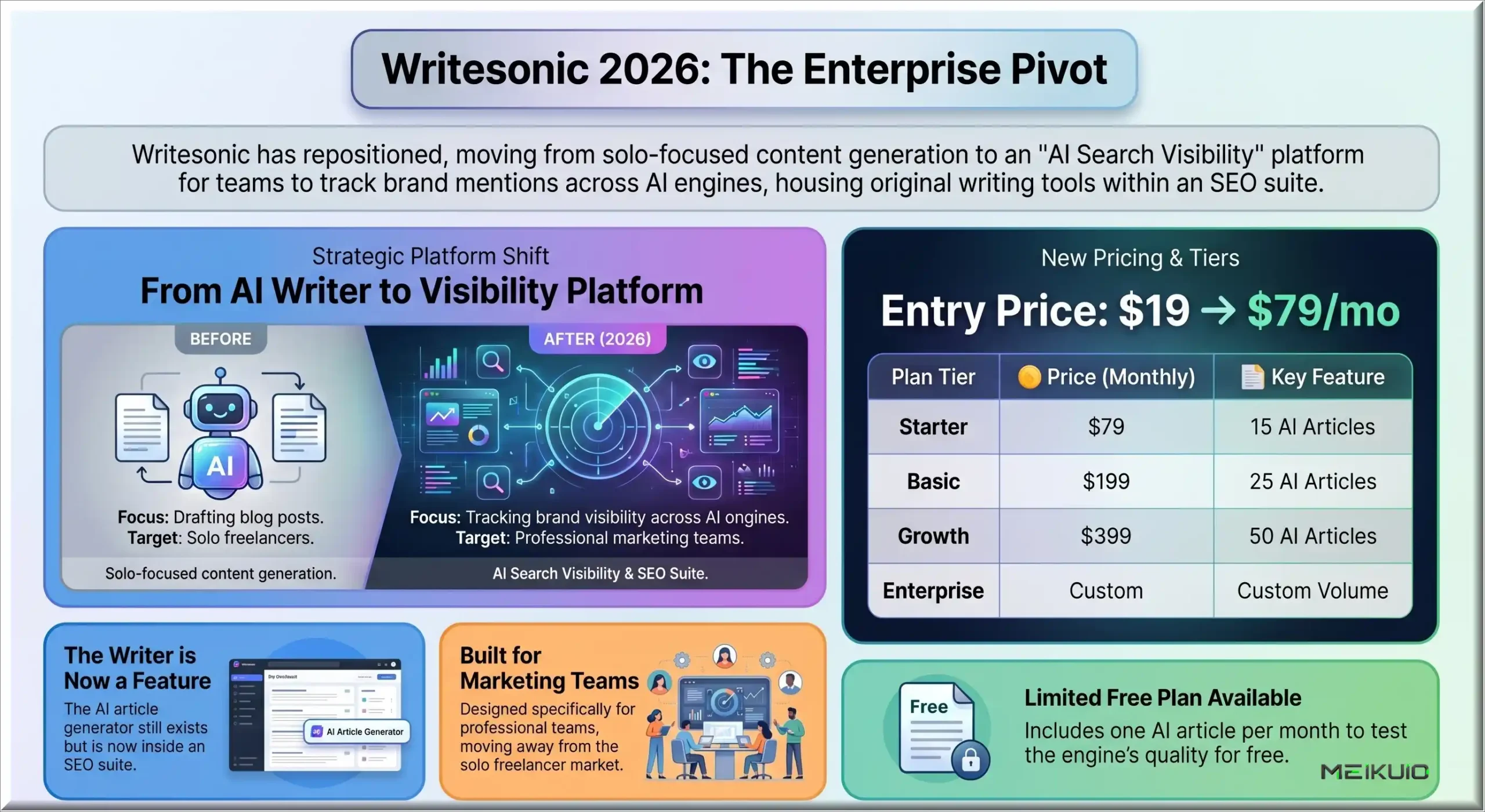
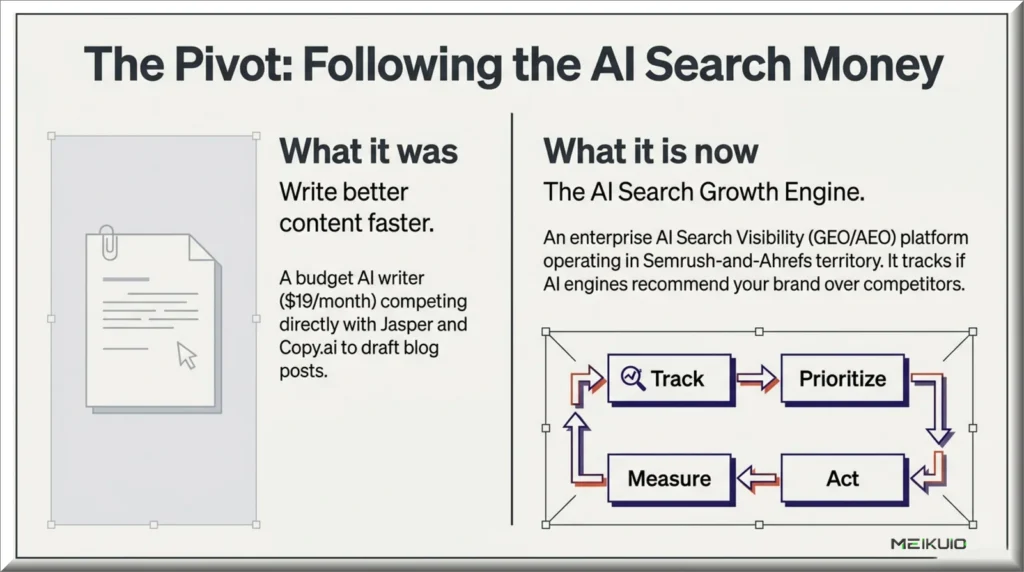
The short version: Writesonic followed the money. As AI search (ChatGPT, Gemini, Google’s AI Overviews) started eating into traditional traffic, the company repositioned around a new, higher-value problem, “is AI recommending your brand or your competitor’s?”, and priced itself for the teams who’ll pay to answer it.
What Writesonic Actually Does Now
Open the homepage today and you’re greeted with “The AI Search Growth Engine,” not “write better content faster.” The core product is built around a loop the company calls Track, Prioritize, Act, Measure: it monitors how often AI engines mention your brand across up to 10 platforms, tells you which gaps to fix, and uses AI agents to produce the content and citations meant to close them.
The toolset reflects that. Inside the dashboard you get keyword research, AI topic clustering, a site audit tool, content gap analysis, an “Answer The People” question finder, and a full AI Search Visibility (GEO) section with bot analytics and an Action Center. This is Semrush-and-Ahrefs territory now, with an AI-search twist on top.
The AI writer is still here, just harder to find
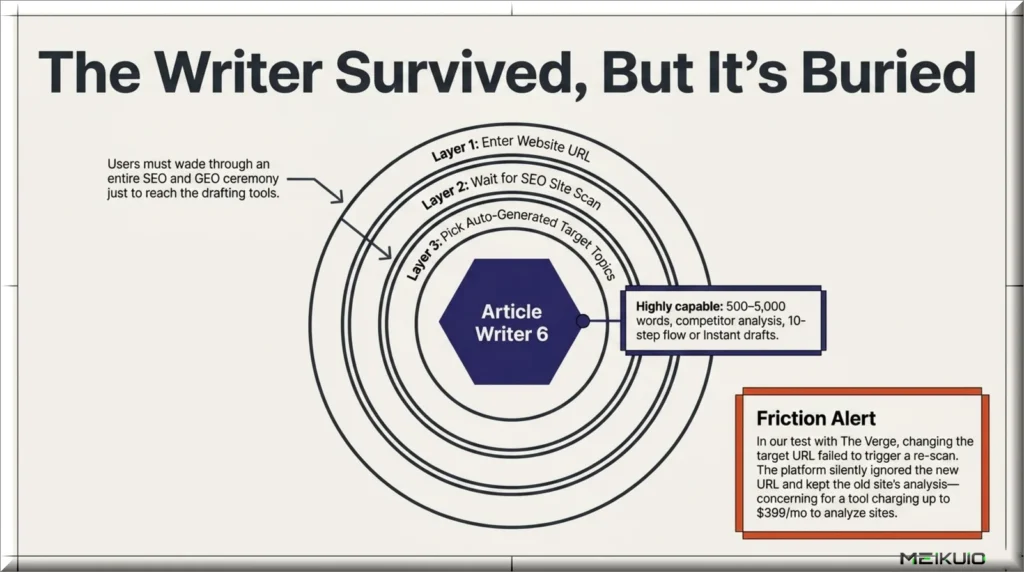
Here’s the part that matters if writing is what you came for: the article writer survived. It’s now labeled “Content Creation” and runs on the company’s Article Writer 6 engine. It’s genuinely capable, with two modes, a 10-Steps Article flow (full control over article type, competitor analysis, keywords, 500–5,000 word length, outline, style, CTA, FAQs) and an Instant Article beta that turns a topic into a draft in about a minute.
More Read

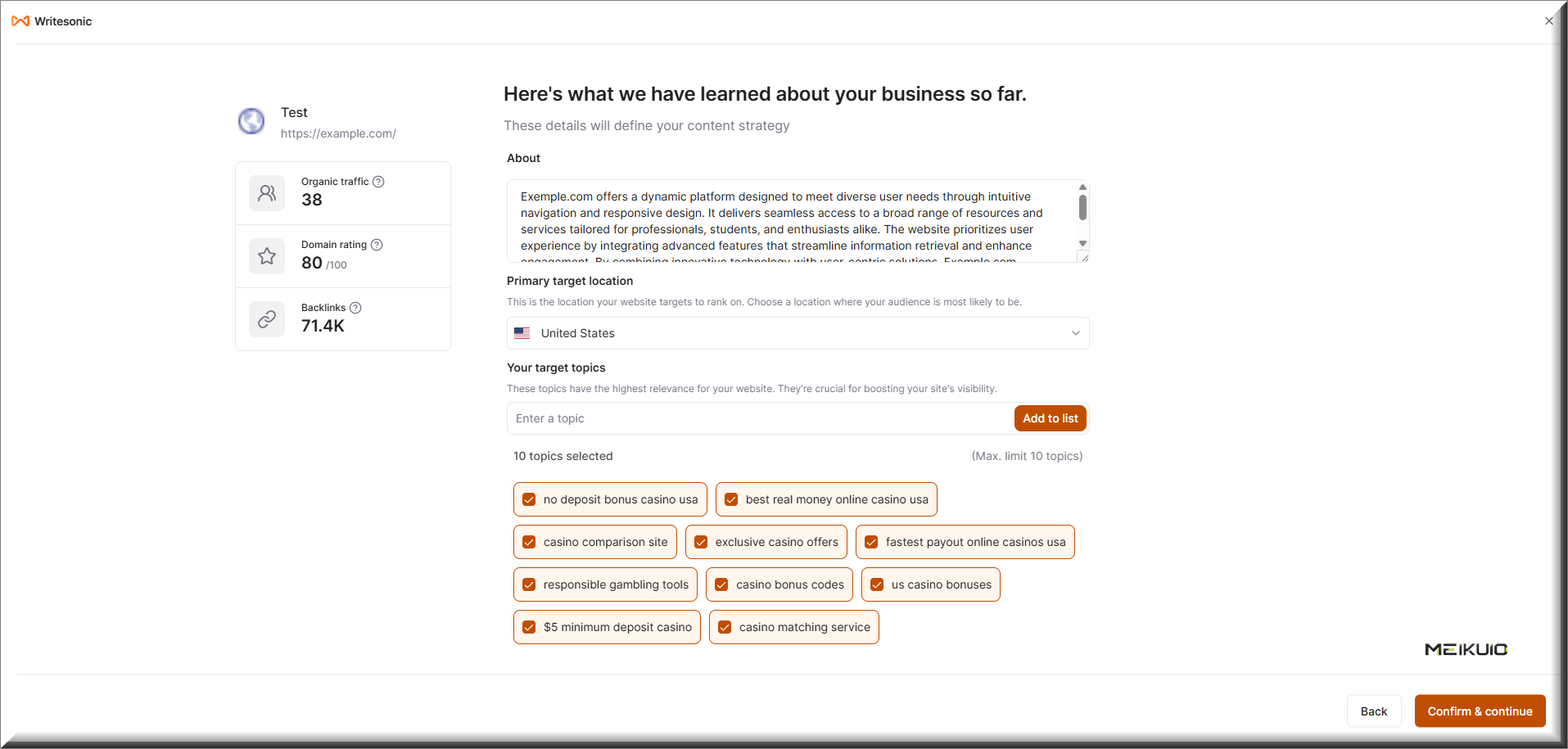
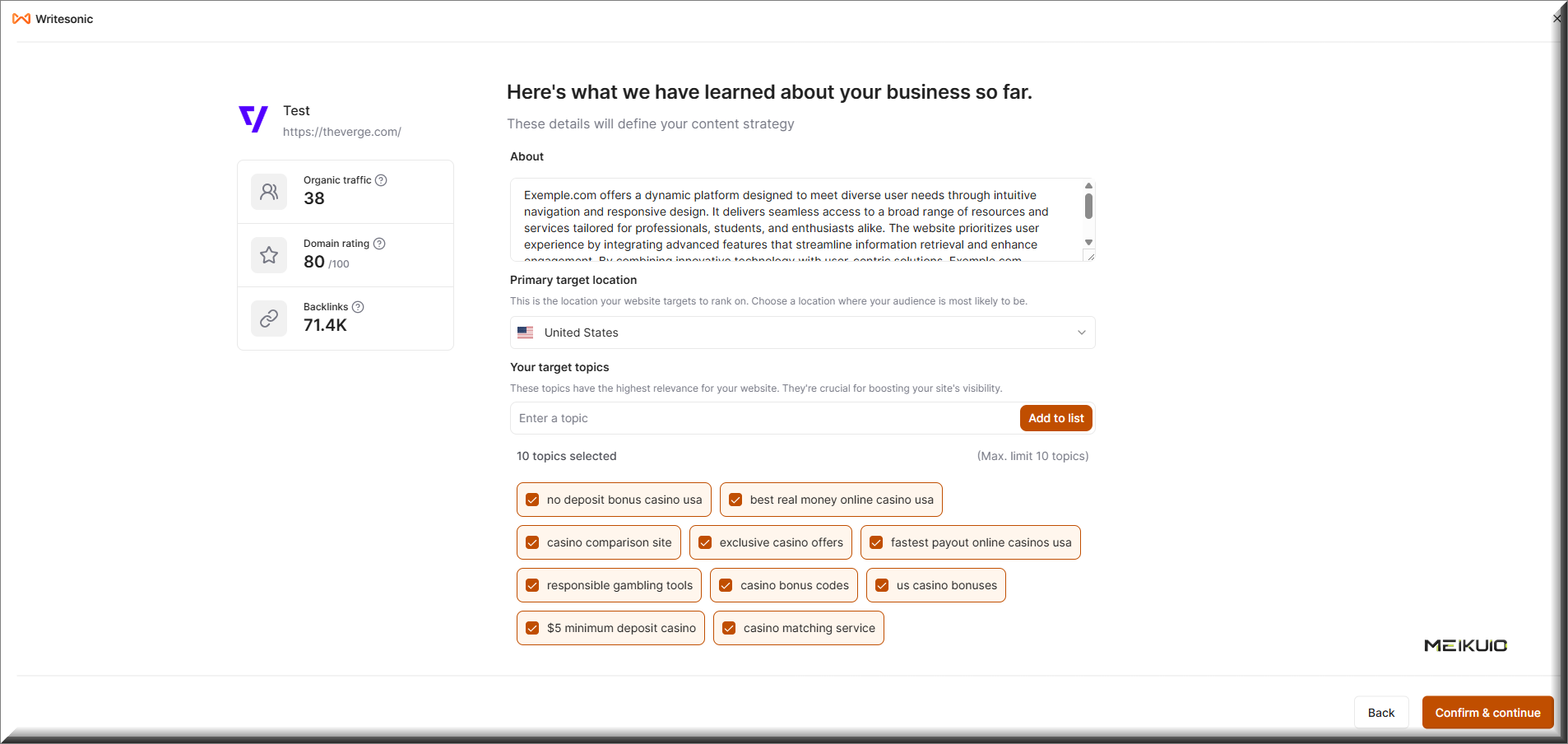
The catch is everything around it. To even reach the writer, you go through an onboarding built entirely for SEO: enter your website, wait for a site scan, pick from ten auto-generated “target topics,” and only then get to content tools. For writers who only want direct drafting without SEO suite overhead, standard LLM chats or our direct breakdown of ChatGPT vs Claude for writing offer cleaner interfaces without the GEO ceremony.
I Tested the Onboarding, and It Stumbled
While setting up a test project, I ran into a rough edge worth mentioning. I entered one website to get through the setup, then went back and changed it to a different, well-known site (The Verge). The platform kept showing the analysis from my first entry, never re-scanning the new domain. Refreshing the page didn’t fix it, it just dropped me into the dashboard with the original site still attached as the project.
It’s a small thing, but for a platform whose headline feature is analyzing your site and charging $79–399/month to do it, silently ignoring a changed URL is the kind of friction that erodes trust on day one.
Field notes
- Product type: AI search visibility (GEO/AEO) platform with built-in SEO and content generation tools.
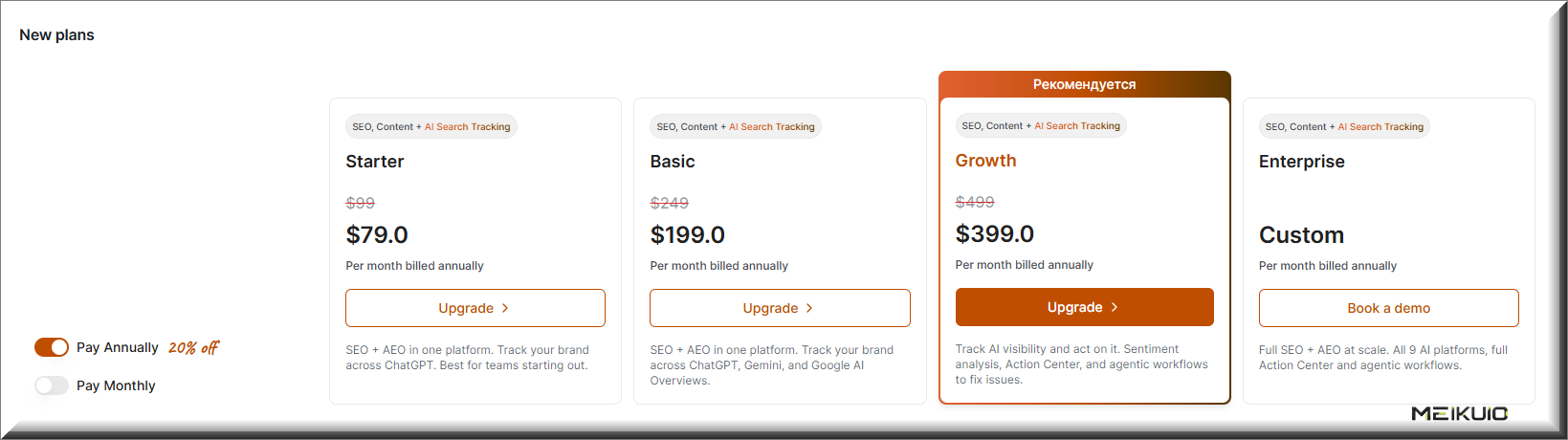
- Entry price: $79/month (Starter, billed annually) or $99/month (billed monthly).
- Free plan: $0/month, includes 1 AI article, 3 AI agent generations, 2 site audits, and AI bot traffic analytics.
- Free trial: 7-day trial of AI search tracking tools only (full content features unlock after).
- Platforms tracked: ChatGPT (Starter) up to 10 engines including Gemini and Google AI Overviews on higher tiers.
- Article capacity: 15 articles/mo (Starter), 25 (Basic), 50 (Growth) running on Article Writer 6.
- Sources: Writesonic live dashboard & pricing testing (May/June 2026), G2/Capterra verified benchmarks.
Plans and pricing
Annual billing saves about 20%. There’s also a free plan worth knowing about: it won’t run a content operation, but one free AI article is enough to judge the writer’s quality before paying.
What Writesonic says it replaces
Inside the app, Writesonic makes its own pitch with a cost comparison, arguing one subscription replaces a stack of separate tools. It’s a useful tell about how the company sees itself now:
Notice where the writing sits: the AI writer is just $69 of a stack Writesonic values at over $1,100. That’s the clearest signal of the shift, the feature that used to be Writesonic is now a small line item in a much bigger pitch.
The Good and the Frustrating
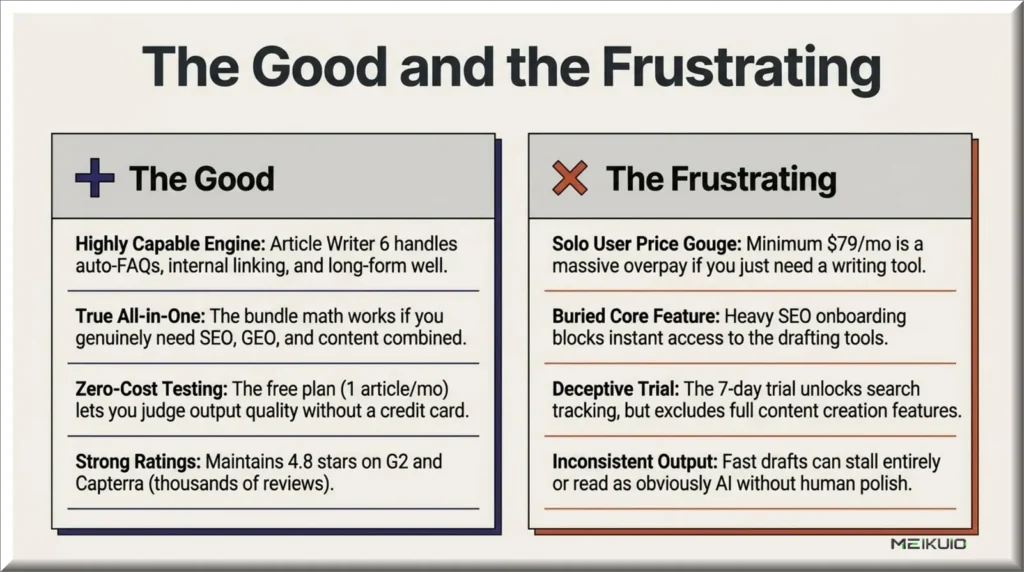
Where it’s strong:
- The writer is capable. Article Writer 6 handles 500–5,000 words, competitor analysis, auto FAQs, and internal linking, not a toy.
- Genuinely all-in-one. If you actually need AI-search tracking and SEO and content in one place, the bundle math can work.
- A free plan exists. One free article means you can test output quality at zero cost.
- Strong third-party ratings. 4.8 on G2 and Capterra across thousands of reviews.
Where it frustrates:
- Expensive for solo users. $79/month minimum (annual) is 4x the old entry price, for a product most freelancers don’t need the bulk of.
- The writer is buried. You wade through an SEO onboarding to reach a tool that used to open in one click.
- Onboarding friction. The site analysis stuck on the wrong domain in my test (see above).
- The trial undersells the writer. The 7-day trial covers tracking tools, not full content features, so the part you might care about most is the part you can’t fully try.
- Output needs editing: Fast drafts, but generated copy often benefits from an AI humanizer or careful editorial review to smooth out recognizable AI phrasing.
- Inconsistent generation: Multiple users report the article generator occasionally stalling or failing on heavy keyword requests before producing final output.
Should You Use Writesonic? A Quick Decision Guide
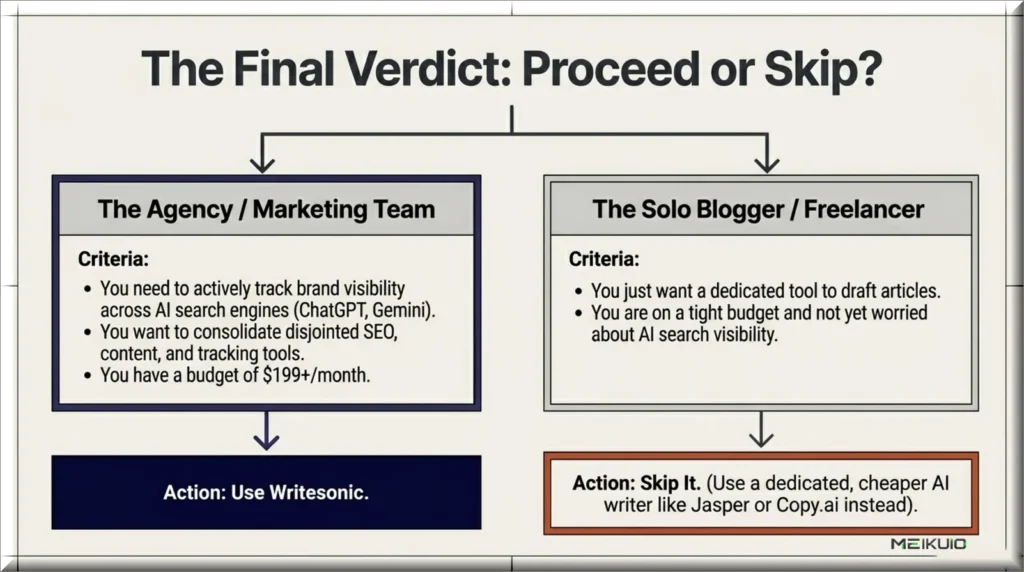
Choose Writesonic if you are:
- A marketing team or agency that needs to track brand visibility across AI engines and act on it.
- Already paying for separate SEO, content, and tracking tools and want to consolidate into a single bill.
- Comfortable at $199+/month and managing multiple projects or client workspaces.
Skip Writesonic if you are:
- A freelancer or solo blogger who just wants to draft articles, you’re paying for a platform you’ll barely use.
- On a tight budget, a dedicated AI writer costs far less for pure copywriting workflows.
- Not yet tracking AI search visibility, the core GEO feature you’re paying for won’t deliver value yet.
For most of our readers who want writing first, a focused tool makes more sense — you can compare pricing directly with Jasper’s plans.
Frequently Asked Questions
Is Writesonic still an AI writer?
Partly. The AI article writer still exists as a feature called Content Creation, running on the Article Writer 6 engine. But Writesonic’s main product is now an AI search visibility platform, and the writer is one tool inside it rather than the focus.
How much does Writesonic cost in 2026?
Plans start at $79/month (Starter, billed annually) or $99/month billed monthly. Basic is $199/mo, Growth is $399/mo, and Enterprise is custom-priced. There’s also a free plan with one AI article per month.
Does Writesonic have a free plan?
Yes. The free plan costs $0 and includes 1 AI article, 3 AI agent generations, 2 site audits, and AI bot traffic analytics. It’s enough to test the writer’s quality before committing to a paid tier.
Is Writesonic worth it for freelancers?
For most freelancers, no. The platform is built and priced for teams that need AI-search tracking alongside content. If you only need to write articles, a dedicated AI writer will cost less and get you there faster.
What’s the difference between Writesonic and Jasper now?
Jasper remains focused on AI writing and marketing content. Writesonic has moved into AI search visibility and SEO, with writing as a secondary feature. They used to be direct competitors; in 2026 they solve different problems.
Can Writesonic track ChatGPT and Gemini mentions of my brand?
Yes, that’s its core function now. The Starter plan tracks ChatGPT only; Basic and Growth add Gemini and Google AI Overviews; Enterprise covers all 10 supported AI platforms.
My Take
Writesonic’s pivot is smart business for them and a headache for individual writers. By moving upstream into GEO and AI brand tracking, they’re chasing enterprise budgets where $199/month is a rounding error. But if you’re a solo creator or freelancer who just wants clean, affordable AI drafting, you’re paying for an entire SEO monitoring department you’ll never touch. Grab the free plan to test Article Writer 6 for yourself, but don’t buy the $79+ subscription unless AI search optimization is already on your agency’s roadmap.
Writesonic in 2026: The Full Picture
USD per month with annual billing; month-to-month prices are 99, 249 and 499 USD. Enterprise custom price is unknown, not zero. The source graphic rounds annual savings to about 20% and compares the former approximately 19 USD entry price. The free plan remains separate.
These are Writesonic’s claimed replacement prices, not independent equivalence or current quotes. Listed components total 1,059 USD while the original marketing graphic says over 1,100 USD. The writer accounts for 69 USD of that pitch. Both the marketing label and the arithmetic discrepancy are retained explicitly.