





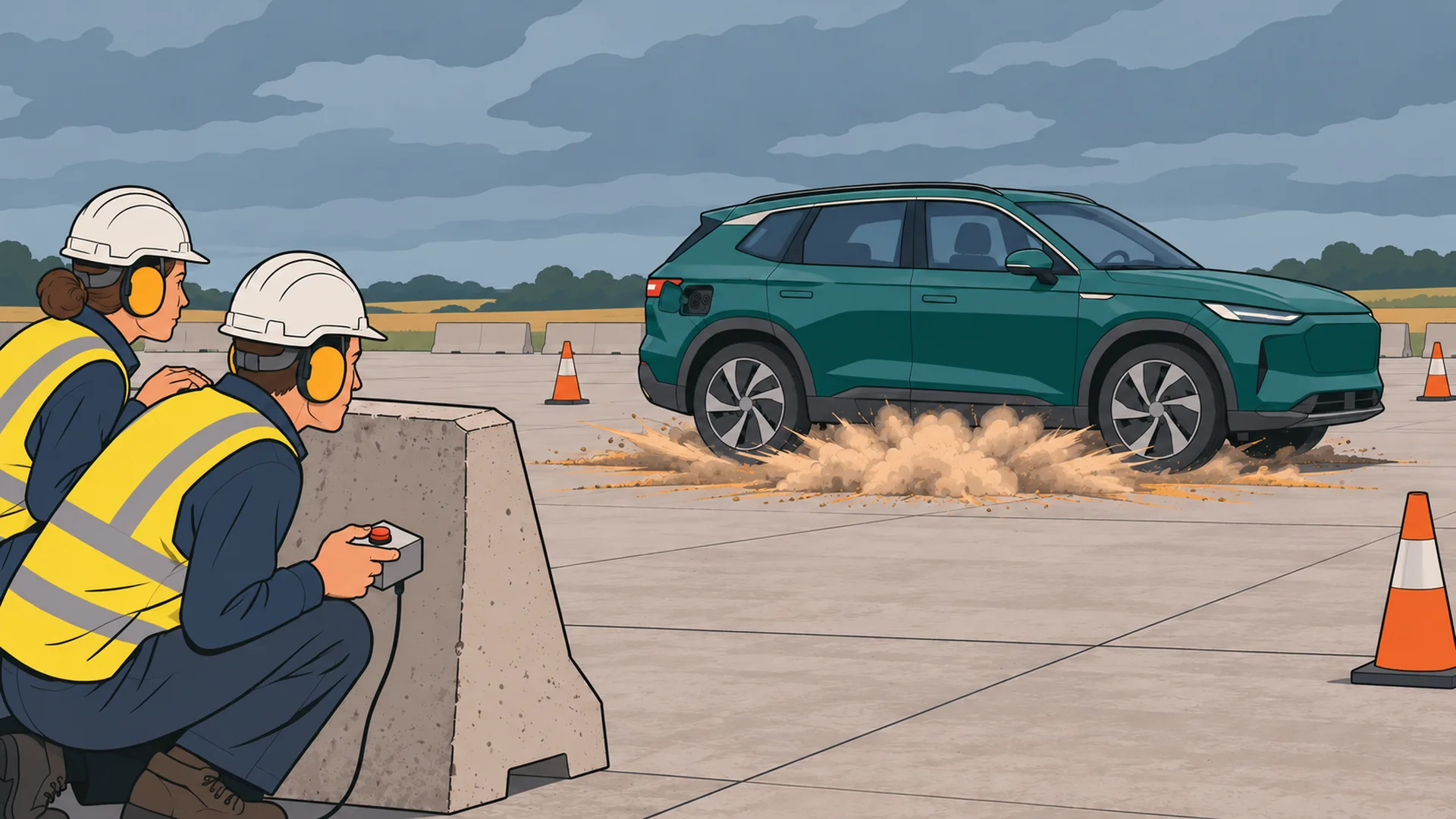
- On November 27 at the Guangzhou auto show, GAC showed Magazine Battery 3.0 and a video of a type 82-2 grenade set off under a car's battery; GAC says the pack didn't burn or explode.
- GAC claims 2,000 joules of underbody protection against the 150-joule minimum in China's GB 38031-2025 standard, in force since July 1, 2026. No test report is public.
- GAC hasn't named a model for the new pack. It sells four models in Australia and, by its own market list, none in the US, Canada or UK.
On November 27, GAC showed a video of a hand grenade going off under an electric SUV’s battery. GAC says the pack didn’t burn or explode. No outside lab has published a report, and GAC hasn’t named a car that will get the pack.
What happened at the Guangzhou auto show?
GAC Group used its home show to present Magazine Battery 3.0, the third version of a pack design it first introduced in 2021, CarNewsChina reports. Wang Qingquan, who heads battery-system development at GAC, presented it on the show floor, IT Home reports. GAC published results from five tests, according to Kuai Keji: leak detection and drainage, a bottom impact, a side pole impact, continuous scraping of the underbody, and a grenade.
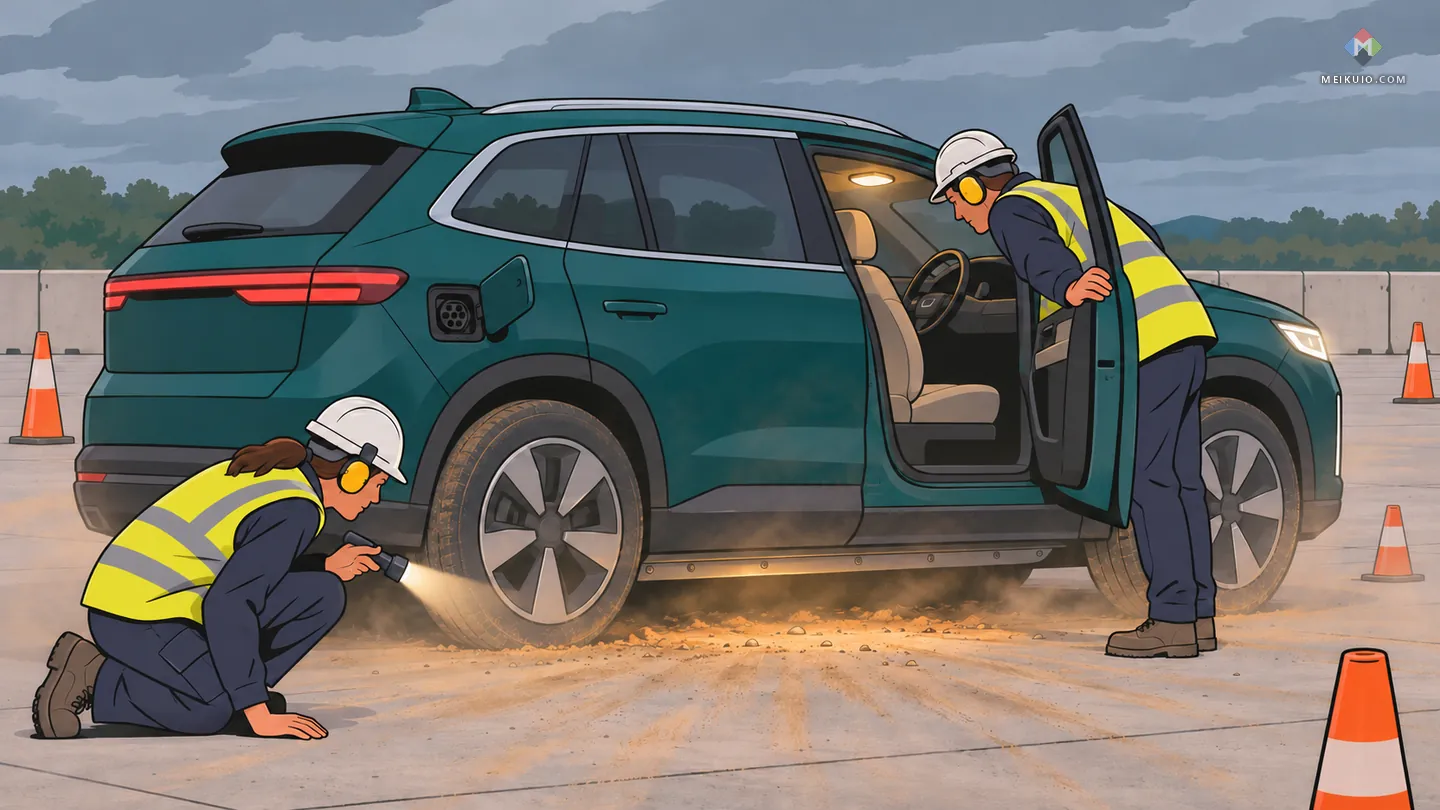
The grenade was a standard-issue type 82-2, set off directly under the battery pack of a parked car. In the video Kuai Keji described, dust blows out from under the car. Staff then walk up, the doors unlock and the car powers on. GAC says the battery didn’t catch fire or explode. Kuai Keji added a caveat that CarNewsChina’s write-up left out: the results describe these test conditions only.
What’s confirmed, and what is GAC’s word?
The grenade is a demonstration, not a rating. China’s mandatory battery standard, GB 38031-2025, took effect on July 1, 2026 and added a bottom impact test for the first time, the government portal gov.cn reported when it was issued. Its summary lists no explosive test. IT Home puts the required impact energy at 150 joules. GAC claims 2,000 for the 3.0 pack, “about 13 times” the minimum, from seven layers of underbody protection. Wang also said the Magazine Battery met the 150-joule bar five years ago. That’s GAC’s claim too.
More Read

Who ran which test matters more than the video. IT Home names the China Automotive Engineering Research Institute (CAERI) for one test only: a car of more than two tonnes driven over obstacles that lifted it, after which it still powered on and drove. IT Home describes the grenade blast as a test GAC ran itself. CarNewsChina’s version says GAC arranged its impact tests with CAERI. I searched for a test report from GAC or CAERI and found none.
Two details got garbled on the way into English. GAC’s leak sensor flags as little as 2 milliliters of liquid inside the pack within three seconds, per IT Home’s Chinese text (2 毫升). CarNewsChina and Interesting Engineering both wrote “2 mm,” which turns a volume into a length. And the steel box that falls apart in the video isn’t the battery. Kuai Keji says it was a separate steel box blown up to show the grenade’s force. An English summary from news18a calls it “the steel enclosure,” which reads like the pack’s own casing failed.
How hard is a 2,000-joule hit?
GAC’s own comparison is a 10-kilogram hammer dropped from seven floors. In US units, by our math: 150 joules is a 22-pound weight falling 5 feet and landing at about 12 mph. At 2,000 joules, the same weight falls 67 feet and lands at about 45 mph. That matches GAC’s seven floors at roughly 2.9 meters each.
Read the “13 times” carefully. GAC hasn’t said whether its 2,000-joule hit used the same setup as the national test, so the multiple is GAC’s comparison, not a certified result. A grenade is a different load again: a short blast and fragments, not one heavy blunt strike from a rock or a curb.
Can you buy a car with this battery?
Not yet. GAC hasn’t said which models get the 3.0 pack or when, CarNewsChina reports. And outside Australia, most of our readers can’t buy a GAC at all: the company’s own market list on its website includes Australia but not the US, Canada or the UK. A show-stand reveal always comes well before an order book, as Tesla Roadster reservation holders know and as anyone trying to buy an eVTOL today finds out.
In Australia, GAC sells the Aion V, Aion UT, Emzoom and M8 PHEV, with dealers from Cairns to Perth. GAC Australia advertises an 8-year, 200,000 km battery warranty on the Aion V. If you’re shopping one, ask the dealer which battery generation the car carries. Don’t assume the grenade pack. Ask what the warranty says about damage from road debris before you sign.
For any EV owner, graded underbody alerts like GAC’s aren’t standard equipment. If you bottom out hard or hit something on the highway, get the underside of the pack looked at. GAC pitches 3.0 on the same logic: its sensors log where each hit landed and how hard, so a damaged pack doesn’t stay in service, IT Home reports. A demo video and a lab listing are different things, the same question we asked when we checked which solar generators carry a safety listing.
Why it matters
China’s new standard turned underbody protection into a pass-or-fail test. GAC is now selling the margin above that line, and a grenade sells it better than a 22-pound weight does. Safety claims only start to mean something once the data is public, the same reason robotaxi safety comparisons live or die on crash reports. Until GAC or CAERI publishes the 2,000-joule numbers, treat them as a spec sheet with a video attached.